
Expanding Cubes: A Geometric and Algebraic Example
Loading the math board and drawing, please wait…
In collections
How to (4): Vectors, CAS and 3D views
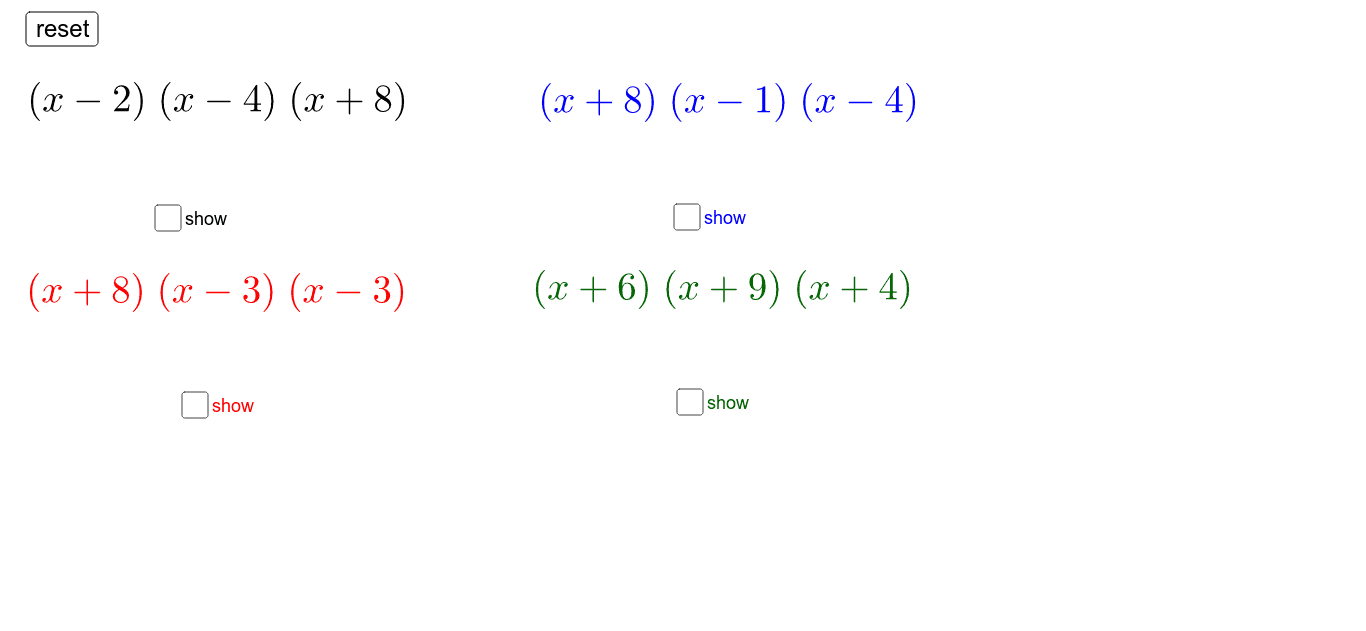
This example demonstrates the concept of expanding a cube in geometry and algebra. Key mathematical concepts include three-dimensional geometry, unfolding principles, and algebraic representation. Construction involves GeoGebra commands such as Random, Factor, and Expand to create unfolding objects. Suitable for high school students or college students learning solid geometry and algebraic transformations.
GeoGebra Commands & Parameters
Random(-9, 9) → aRandom(-9, 9) → cRandom(-9, 9) → bFactor((((x + a) * (x + b)) * (x + c))) → fExpand(f) → f_1Random(-9, 9) → dRandom(-9, 9) → eRandom(-9, 9) → lRandom(-9, 9) → mRandom(-9, 9) → nRandom(-9, 9) → pRandom(-9, 9) → qRandom(-9, 9) → rRandom(-9, 9) → sFactor((((x + d) * (x + e)) * (x + l))) → hExpand(h) → h_1Factor((((x + m) * (x + n)) * (x + p))) → tExpand(t) → t_1Factor((((x + q) * (x + r)) * (x + s))) → gExpand(g) → g_1
AI Drawing Prompt Reference
Draw an example showing the expansion of a cube geometrically and algebraically, including three randomly generated cubes, each expanded into a flat shape through algebraic expressions, demonstrating three-dimensional geometry, unfolding principles, and algebraic representation, emphasizing randomness and geometric construction relationships.
The prompt above was compiled from the original drawing commands and is for reference only.