
Euler's Function in Complex Plane and Cartesian Coordinates
Loading the math board and drawing, please wait…
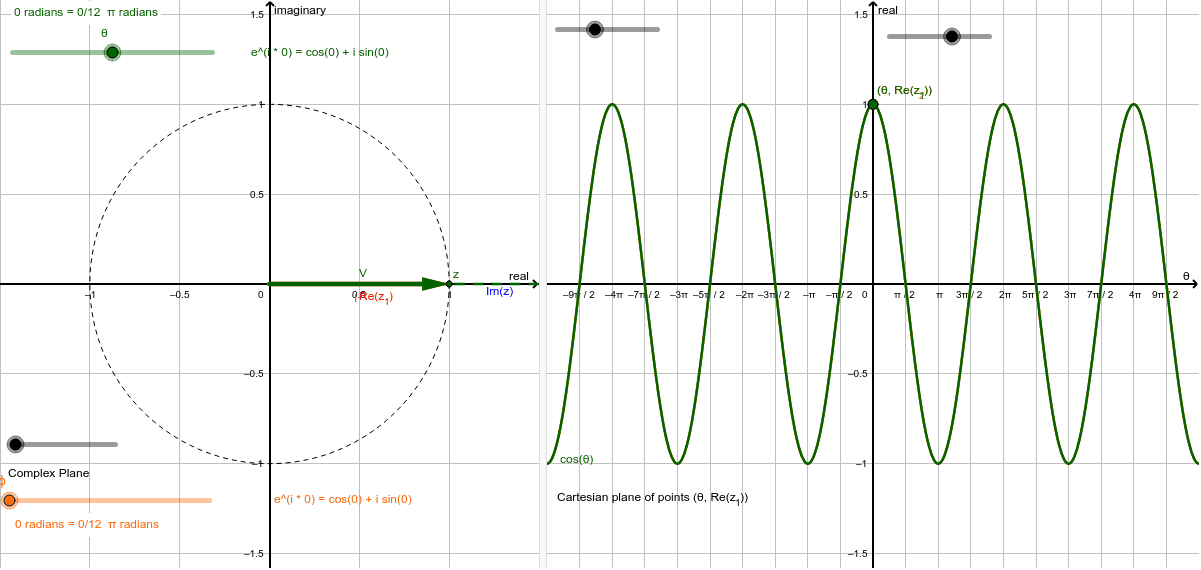
This example demonstrates Euler's function in both the complex plane and Cartesian coordinates. Key mathematical concepts include complex numbers, trigonometry, and coordinate geometry. Using GeoGebra commands such as Circle, Segment, Ray, CurveCartesian, and Vector, dynamic observations of Euler's function in different coordinate systems can be made. Suitable for high school mathematics education and learning.
GeoGebra Commands & Parameters
Circle((0, 0), 1) → cSegment(B, z_1) → gRay(O, z_1) → hCurveCartesian(((0.02 * t) * cos(t)), ((0.02 * t) * sin(t)), t, 0, θ) → kCurveCartesian(((-0.02 * t) * cos(t)), ((-0.02 * t) * sin(t)), t, θ, 0) → lSegment(C, z_1) → jVector(O, z_1) → VVector(O, z_2) → I
AI Drawing Prompt Reference
Draw a unit circle in the complex plane, a ray from the origin to a point on the circle, and segments connecting the origin to the point and another point on the circle. Also, plot two curves extending from the origin in opposite directions and show vectors from the origin to two different points.
The prompt above was compiled from the original drawing commands and is for reference only.