
Escher's Stairway: 3D Prism and Polyhedron Sequence Construction
Loading the math board and drawing, please wait…
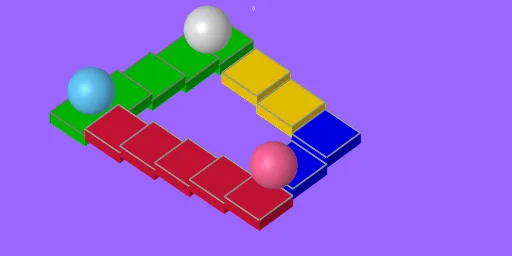
This example demonstrates a 3D geometric construction inspired by Escher's stairway, creating an illusion of infinite steps through a sequence of prisms and spheres. Core mathematical concepts include solid geometry (prisms, polyhedra, centroids), sequence generation, parametric curves, and percentage-based distribution. Construction highlights: using GeoGebra commands such as Point, Intersect, Polygon, Prism, Centroid, Sequence, Join, PolyLine, Element, and Sphere, the model builds multiple faces (e.g., faceABFE, faceBCGF) and edges (edgeAE, edgeBF), with lists (list1, list2, list3) to arrange the stair-like pattern. Suitable for high school or college-level solid geometry instruction, and for interdisciplinary art-math projects exploring spatial transformations and sequential construction.
GeoGebra Commands & Parameters
Point(yAxis) → DIntersect(yAxis, zAxis) → APoint(xAxis) → BPolygon(A, B, C, D) → poly1, a, b, c, dPrism(poly1, (3 * h)) → e, E, edgeAE, edgeBF, edgeCG, edgeDH, edgeEF, edgeFG, edgeGH, edgeEH, F, G, H, faceABFE, faceBCGF, faceCDHG, faceADHE, faceEFGHCentroid(faceEFGH) → JSequence(Translate[faceEFGH, Vector[((1, 0, (2 * h)) * k)]], k, 1, 5) → l1Sequence(Centroid[Element[l1, i]], i, 1, Length[l1]) → l5Sequence(Translate[Element[l1, 5], Vector[((0, 1, (2 * h)) * k)]], k, 1, 5) → l2Sequence(Centroid[Element[l2, i]], i, 1, Length[l1]) → l6Sequence(Translate[Element[l2, 5], Vector[((-1, 0, (2 * h)) * k)]], k, 1, 2) → l3Sequence(Centroid[Element[l3, i]], i, 1, Length[l3]) → l7Sequence(Translate[Element[l3, 2], Vector[((0, -1, (2 * h)) * k)]], k, 1, 2) → l4Sequence(Centroid[Element[l4, i]], i, 1, Length[l4]) → l8Sequence(Translate[e, Vector[((1, 0, (2 * h)) * k)]], k, 1, 5) → list1Sequence(Translate[Element[list1, 5], Vector[((0, 1, (2 * h)) * k)]], k, 1, 5) → list2Sequence(Translate[Element[list2, 5], Vector[((-1, 0, (2 * h)) * k)]], k, 1, 2) → list3Join({l5, l6, l7, l8}) → l9Sequence(Segment[Element[l9, i], Element[l9, i + 1]], i, 1, Length[l9]) → l10PolyLine(l9) → fPoint(f) → IElement(l7, Length[l7]) → KSequence(Translate[Element[list3, 2], Vector[((0, -1, (2 * h)) * k)]], k, 1, 2) → list4Sphere(I + (0, 0, 0.5), 0.5) → gPoint(f) → LSphere(L + (0, 0, 0.5), 0.5) → iPoint(f) → MSphere(M + (0, 0, 0.5), 0.5) → j
AI Drawing Prompt Reference
In 3D space, start from the coordinate axes intersection to build a quadrilateral-based prism with height three units. Translate and copy the prism's top face horizontally five times to form the first row of steps; then translate the last top face vertically five times for the second row; next, translate in the opposite horizontal direction twice, and then vertically twice, creating a spiral ascending staircase sequence. Connect the centroids of each top face in order to form a spatial polyline. Pick three points on this polyline and place three spheres with radius half a unit, each centered slightly above the line. The overall effect mimics Escher's infinite stairway illusion.
The prompt above was compiled from the original drawing commands and is for reference only.