
Equilateral Triangle Animation
Loading the math board and drawing, please wait…
In collections
Congruence (CO) Cluster
Congruence (Vol 2)
CCSS High School: Geometry (Congruence) Volume 2
CCSS High School: Geometry (Congruence) Volume 2
CCSS High School: Geometry (Congruence) Volume 2
Geometry (Congruence) Volume 2
CCSS High School: Geometry (Congruence) Volume 2
CCSS High School: Geometry (Congruence) Volume 2
CCSS High School: Geometry (Congruence) Volume 2
CCSS High School: Geometry (Congruence) Volume 2
CCSS High School: Geometry (Congruence) Volume 2
CCSS High School: Geometry (Congruence) Volume 2
CCSS High School: Geometry (Congruence) Volume 2
Gail LeBlancCCSS High School: Geometry (Congruence) Volume 2
CCSS High School: Geometry (Congruence) Volume 2
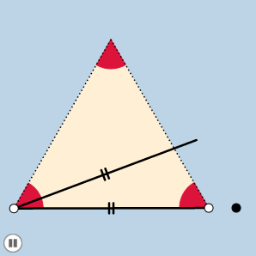
This example demonstrates the dynamic changes of an equilateral triangle. Key mathematical concepts include the properties of equilateral triangles, angles, and trigonometric functions. Using GeoGebra commands such as Line, Ray, Point, Rotate, Angle, Circle, etc., the dynamic changes of the equilateral triangle can be constructed. Suitable for students at the junior high school level and above to learn about geometric transformations and dynamic graphics.
GeoGebra Commands & Parameters
Line(A, B) → fRay(A, B) → gPoint(g) → CRotate(C, π / 3, A) → C'Angle(C, A, C') → αRotate(A, (-(π / 3)), C) → A'Angle(A', C, A) → βCircle(A, C) → cCircle(C, A) → dIntersect(c, d, 1) → DSegment(A, D) → hSegment(A, C) → iSegment(C, D) → jCircle(A, (0.15 * i)) → eIntersect(e, h, 1) → EIntersect(e, i, 1) → FCircleSector(A, F, E) → kPolygon(A, C, D) → poly1, d_1, a_1, c_1Dilate(A, If[0 < a ≤ 1, 1 - a, 0], C) → A'_1Segment(A, A'_1) → lDilate(A, If[1 < a ≤ 2, 2 - a, 0], C) → A'_2Vector(A, A'_2) → uTranslate(k, u) → k'Rotate(k', If[2 < a ≤ 3, (((a - 2) * 2) * π / 3), (2 * π / 3)], C) → k''Dilate(C, If[3 < a ≤ 4, 4 - a, 0], D) → C'_1Vector(C, C'_1) → vTranslate(k'', v) → k'''Rotate(k''', If[4 < a ≤ 5, (((a - 4) * 2) * π / 3), (2 * π / 3)], D) → pDilate(D, If[5 < a ≤ 6, 6 - a, 0], A) → D'Dilate(D, If[5 < a ≤ 6, 6 - a, 0], C) → D'_1Segment(D, D') → mSegment(D, D'_1) → nRotate(A, If[6.5 < a ≤ 7.5, ((a - 6.5) * π / 3), π / 3], A) → A'_3Rotate(A'_1, If[6.5 < a ≤ 7.5, ((a - 6.5) * π / 3), π / 3], A) → GSegment(A'_3, G) → l'Rotate(A, If[7.5 < a ≤ 8.5, ((-(a - 7.5)) * π / 3), ((-π)) / 3], C) → A'_4Rotate(A'_1, If[7.5 < a ≤ 8.5, ((-(a - 7.5)) * π / 3), ((-π)) / 3], C) → HSegment(A'_4, H) → l'_1