
Equilateral 2N-gon Tiling
Loading the math board and drawing, please wait…
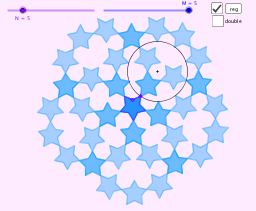
This example demonstrates an equilateral 2N-gon tiling inspired by Regolo54's hexagon tiling. It showcases the symmetry and geometric transformations of polygon tilings. Using GeoGebra commands such as Rotate, If, Sequence, Point, Join, and Polygon, specific symmetric polygons can be constructed. Suitable for high school and above students to learn about geometric transformations and polygon tilings.
GeoGebra Commands & Parameters
Rotate(A, (-360 * ° / N)) → A'If(N ≟ 4, (0, 0) + Vector[A] + OrthogonalVector[Vector[A]], Intersect[Line[A, (0, 0)], Rotate[OrthogonalLine[A, Line[A, (0, 0)]], (-360 * ° / N)]]) → CIf(N ≟ 4, 45*°, ((Min[Angle[A, C, A'], Angle[A', C, A]] * 180) * ° / π)) → αSequence(Rotate[A, ((i * 360) * ° / N), (0, 0)], i, 1, N) → list1Rotate(Ray[(0, 0), A], (180 * ° / N)) → aPoint(a) → BSequence(Rotate[B, ((i * 360) * ° / N), (0, 0)], i, 1, N) → list2Join(Sequence[{Element[list1, i], Element[list2, i]}, i, 1, N]) → list3Polygon(list3) → poly1If(Mod[N, 2] ≟ 0, 1, Distance[B, (0, 0)] / Distance[A, (0, 0)]) → ulongRotate(OrthogonalLine[A, Line[A, (0, 0)]], (-360 * ° / N)) → bSequence(Rotate[poly1, ((2 * i) * α), C], i, 0, c - 1) → list5Circle(C, A) → dIntersect(OrthogonalLine[A, Vector[A]], a) → DSequence(Rotate[list5, ((((2 - f) * i) * 360) * ° / N), (0, 0)], i, 0, M - 1) → list6