
Equiangular Spirals in Plants - Fibonacci Numbers
Loading the math board and drawing, please wait…
In collections
Logarithmic Spiral and Fibonacci Numbers
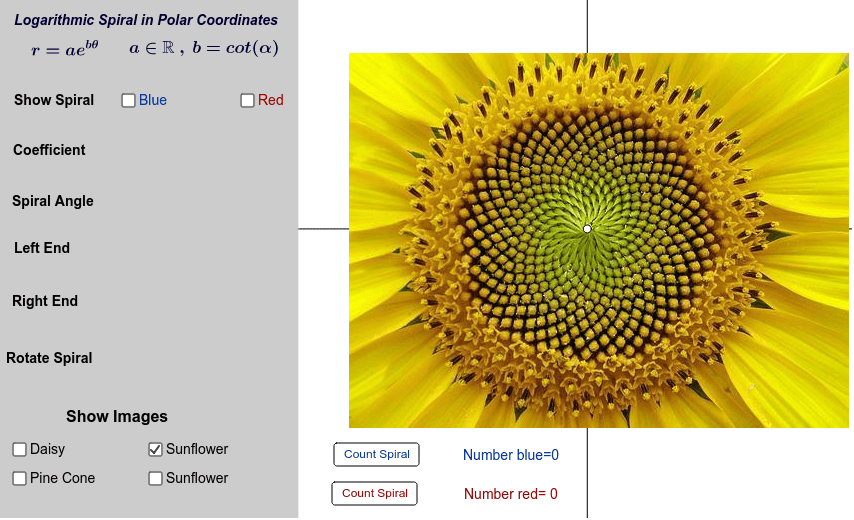
This example demonstrates the equiangular (logarithmic) spirals found naturally in plants, allowing measurement and counting. Key math concepts include equiangular spirals, Fibonacci numbers, logarithmic spirals, and coordinate geometry. Constructed using GeoGebra commands like Corner, CurveCartesian, and Polygon. Suitable for high school and above, exploring mathematical patterns in nature and the application of Fibonacci sequences.
GeoGebra Commands & Parameters
Corner(1) → AACorner(2) → BBCurveCartesian(a_1 * exp(b * t) * cos(t + p), a_1 * exp(b * t) * sin(t + p), t, t_{0 left}, t_{0 right}) → cCurveCartesian(a_2 * exp(b_1 * t) * cos(t + q), a_2 * exp(b_1 * t) * sin(t + q), t, t_{2 left}, t_{2 right}) → mPolygon(Corner[1], (x(Corner[1]) + 0.35 * Distance[Corner[1], Corner[2]], y(Corner[1])), (x(Corner[4]) + 0.35 * Distance[Corner[1], Corner[2]], y(Corner[4])), Corner[4]) → poly1, a, j, l, r
AI Drawing Prompt Reference
Draw equiangular spirals found naturally in plants, incorporating the concepts of equiangular spirals, Fibonacci numbers, and logarithmic spirals. Start by defining two corner points, then draw two equiangular spirals, and finally use the corner points and spirals to create a quadrilateral.
The prompt above was compiled from the original drawing commands and is for reference only.