
Equiangular Spiral - Parametric Equation
Loading the math board and drawing, please wait…
In collections
Logarithmic Spiral and Fibonacci Numbers
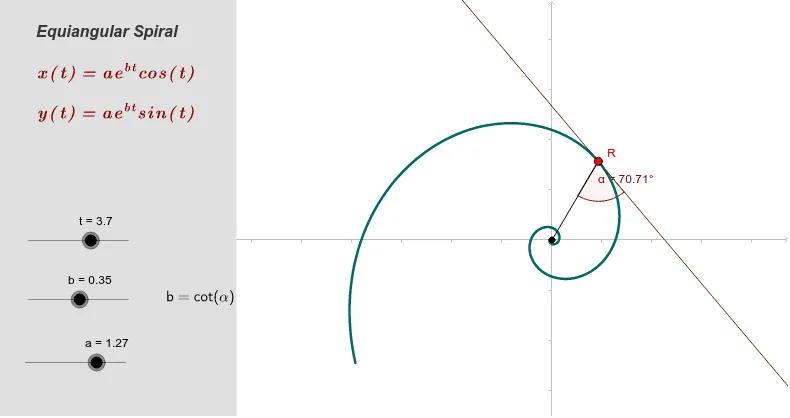
This example demonstrates an equiangular spiral, also known as a logarithmic spiral, which is a curve with a specific angle property. Key concepts include parametric equations, angles, and logarithmic relationships. Using GeoGebra commands such as CurveCartesian, Tangent, Segment, and Angle, the construction of the equiangular spiral is shown. Suitable for high school mathematics education or research.
GeoGebra Commands & Parameters
CurveCartesian(((a * exp((b * tt))) * cos(tt)), ((a * exp((b * tt))) * sin(tt)), tt, left, t) → cPoint(c) → RTangent(R, c) → dSegment(O, R) → ePoint(d) → BAngle(O, R, B) → αPolygon(Corner[1], (x(Corner[1]) + (0.3 * Distance[Corner[1], Corner[2]]), y(Corner[1])), (x(Corner[4]) + (0.3 * Distance[Corner[1], Corner[2]]), y(Corner[4])), Corner[4]) → poly1, f, g, h, i
AI Drawing Prompt Reference
Draw an equiangular spiral using the parametric equation (a * exp(b * t) * cos(t), a * exp(b * t) * sin(t)), where t ranges from left to t. First, plot the curve, then select a point R on the curve, draw the tangent line d at R, the segment e from the origin O to R, the point B on the tangent line d, and the angle α formed by O, R, and B. Finally, draw a segment from O, offset by 30% to the right, to form a quadrilateral.
The prompt above was compiled from the original drawing commands and is for reference only.