
Equations of Perpendicular Lines (Open Middle)
Loading the math board and drawing, please wait…
This example demonstrates interactive exploration of the algebraic relationship between equations of perpendicular lines. Key math concepts include the negative reciprocal property of slopes, point-slope form of linear equations, and problem-solving in analytical geometry. GeoGebra commands and objects like Textfield, Intersect, Mode, If, Point, Polygon, Dilate, Vector, Translate, Segment, Rotate, Angle are utilized in construction. Suitable for high school students to understand the algebraic properties of perpendicular lines and enhance equation application skills.
GeoGebra Commands & Parameters
Textfield(a) → InputBox1Textfield(b) → InputBox2Textfield(c) → InputBox3Textfield(d) → InputBox4Textfield(e) → InputBox5Textfield(f) → InputBox6Intersect(eq2, eq1) → BMode(l1) → l2If(Length[l2] ≟ 0, "No digits repeat!", "Repeated digits exist.") → text2Point(eq1) → APoint(eq2) → CPoint(eq2) → DPoint(eq1) → EPolygon(A, F, G) → t1, g_1, a_1, f_1Dilate(A, If[0 < g ≤ 1, 1 - g, 0], C) → A'Vector(A, A') → uTranslate(A, u) → A'_{1}Translate(F, u) → F'Translate(G, u) → G'Polygon(A'_{1}, F', G') → t1', g', a'_{1}, f'Translate(A, u) → A'_{2}Translate(F, u) → F'_{1}Translate(F, u) → F'_{2}Translate(G, u) → G'_{1}Segment(A, G) → hTranslate(A, u) → A'_{3}Translate(G, u) → G'_{2}Rotate(A'_{1}, If[1 < g ≤ 2, ((g - 1) * π / 2), π / 2], C) → HRotate(F', If[1 < g ≤ 2, ((g - 1) * π / 2), π / 2], C) → F''Rotate(G', If[1 < g ≤ 2, ((g - 1) * π / 2), π / 2], C) → G''Polygon(H, F'', G'') → t1'', g'', h_1, f''Angle(C, B, A) → α
AI Drawing Prompt Reference
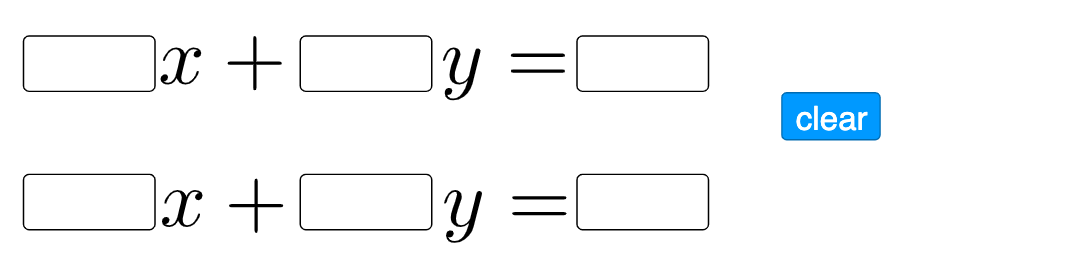
On a coordinate plane, ask the user to input two linear equations (forming two lines) and choose additional equation inputs that define key points associated with each line. Construct the intersection point of the two lines, then place points on each line to form an initial triangle-shaped polygon. Using the intersection-related point as the center, apply a similarity scaling to the triangle by a parameter-dependent factor, then translate the scaled triangle to create a shifted copy. Next, rotate the translated points about the same intersection point by a parameter-controlled angle that is piecewise based on the input, yielding a rotated polygonal region. Finally, mark the angle formed by the rays from the center through the constructed points.
The prompt above was compiled from the original drawing commands and is for reference only.