
Epicyclic Gear
Loading the math board and drawing, please wait…
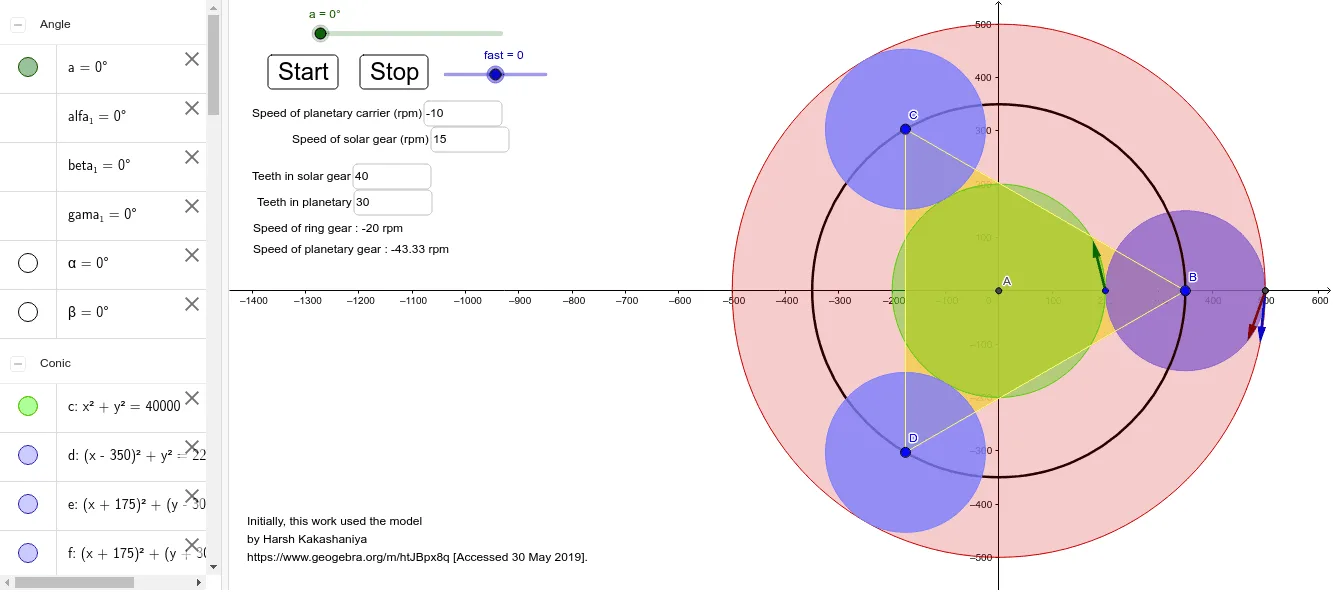
This example demonstrates the working principle of an epicyclic gear. It involves concepts of circular motion and rotation angles. Using GeoGebra commands such as Circle, Rotate, and Polygon, the motion trajectory of the epicyclic gear is dynamically displayed. Suitable for high school or university mechanical engineering and mathematics courses.
GeoGebra Commands & Parameters
Min(abs(ncarrier), abs(nring)) → nrot_2Min(abs(nsolar), abs(ncarrier)) → nrot_1Intersect(xAxis, yAxis) → ACircle(B, (Tplanetary * 5)) → dCircle(A, (Tsolar * 5)) → cIntersect(c, d, 1) → HRotate(I, alfa_1, A) → I'Polygon(C, B, D) → poly1, d_1, c_1, b_1Textfield(ncarrier) → Input_ncarrierTextfield(Tsolar) → Input_TsolarTextfield(Tplanetary) → Input_TplanetaryCircle(A, ((Tsolar + Tplanetary) * 5)) → gCircle(E, (Tring * 5)) → hCircle(D, (Tplanetary * 5)) → fCircle(C, (Tplanetary * 5)) → eIntersect(c, e, 1) → FIntersect(c, f, 1) → GPolygon(G, F, H) → poly2, h_1, g_1, f_1Rotate(L, beta_1, A) → L'Angle(L, A, L') → βAngle(I, A, I') → αTextfield(nsolar) → Input_nsolarRotate(I', (30° * nsolar / (abs(nsolar) + 1)), A) → I''Vector(I', I'') → uRotate(L', ((30° * nring / (abs(nring) + 1)) * Tsolar / Tring), A) → L''Vector(L', L'') → vRotate(J, gama_1, B) → J'Rotate(J', ((30° * nplanetary / (abs(nplanetary) + 1)) * Tsolar / Tplanetary), B) → J''Vector(J', J'') → w