
Ellipse: Constructions with Ancient Tools
Loading the math board and drawing, please wait…
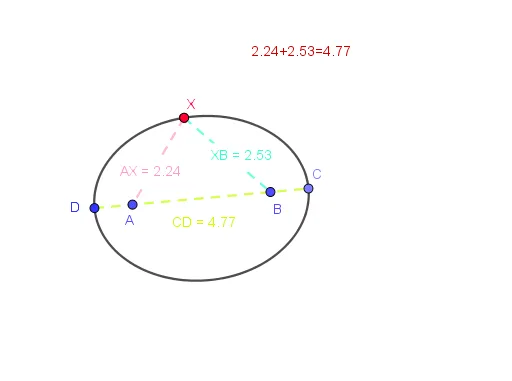
This example demonstrates how to construct an ellipse using only ancient geometric tools (such as straightedge and compass), and illustrates the relationship between distances from a moving point on the ellipse to its two foci. The core mathematical concepts include the definition of an ellipse (constant sum of distances to two fixed points), geometric construction, distance measurement, and function graphing. Construction highlights: using GeoGebra commands such as Line, Point, Ellipse, Distance, Intersect, and Segment, the construction creates points A and B as foci, draws ellipse f, places a moving point X on the ellipse, measures distances AX and XB, and also constructs auxiliary points C, D and segments, with text objects displaying distance values for dynamic demonstration. Suitable for high school and above, this is ideal for learning conic sections, geometric constructions, or the history of mathematics, and for exploring ellipse properties with ancient tools.
GeoGebra Commands & Parameters
Line(A, B) → fPoint(f) → CEllipse(A, B, C) → cPoint(c) → XDistance(A, X) → distanceAXDistance(X, B) → distanceXBIntersect(c, f, 2) → DDistance(C, D) → distanceCDDistance(A, X) → AXDistance(X, B) → XBDistance(D, C) → DCSegment(X, A) → gSegment(X, B) → hSegment(D, C) → i