
Element H Geometric Construction and Transformation
Loading the math board and drawing, please wait…
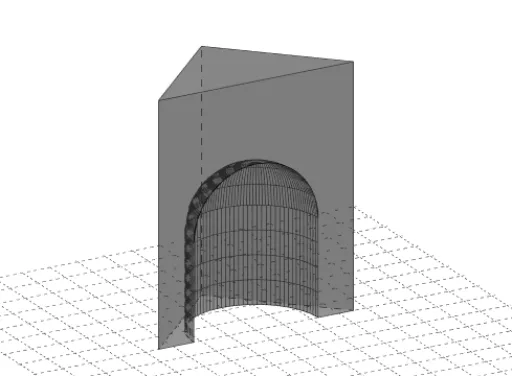
This example demonstrates the construction and transformation of element H in geometric transformations. Key mathematical concepts include vector transformation, geometric construction, and spatial point positioning in three-dimensional space. The construction involves using GeoGebra commands such as Rotate, Segment, Intersect, Circle, and Plane to build the element H's geometry, along with objects like Semicircle and Surface for spatial context. This example is suitable for high school students learning geometric transformations and coordinate geometry, useful for teaching and self-exploration.
GeoGebra Commands & Parameters
Rotate(B, 45°, A) → B'Segment(A, B') → fIntersect(f, yAxis) → CCircle(C, 0.1) → cSegment(A, C) → gSegment(C, B) → hIntersect(c, g, 1) → DIntersect(c, h, 1) → ECircle(O, straal) → dIntersect(d, xAxis, 1) → FIntersect(d, xAxis, 2) → GSemicircle(F, G) → eSurface((sqrt(straal^(2) - h^(2)) * cos(t)), (sqrt(straal^(2) - h^(2)) * sin(t)), h + (1.5 * straal), t, 0°, 180°, h, 0, straal) → aSurface((sqrt(straal^(2) - h^(2)) * cos(t)), (sqrt(straal^(2) - h^(2)) * sin(t)), h + (1.5 * straal), t, 0°, 360°, h, 0, straal) → bSurface((straal * cos(t)), (straal * sin(t)), hh, t, 0°, 180°, hh, 0, (1.5 * straal)) → iSurface((straal * cos(t)), (straal * sin(t)), hh, t, 0°, 360°, hh, 0, (1.5 * straal)) → jSegment(L, M) → kSegment(L, A) → lSegment(M, B) → mCircleArc(N, J, P) → pCircleArc(N, P, I) → qPoint(q) → QPoint(q) → RPoint(q) → SPoint(q) → TPoint(q) → ULine(P, k) → rLine(Q, k) → sLine(R, k) → tLine(S, k) → f_1Line(T, k) → g_1Line(U, k) → h_1Intersect(r, l) → VIntersect(l, s) → WIntersect(l, t) → ZIntersect(l, f_1) → A_1Intersect(l, g_1) → B_1Intersect(l, h_1) → C_1Polygon(V, W, Q, P) → vierhoek1, v, w, q_1, p_1Polygon(W, Z, R, Q) → vierhoek2, w_1, z_1, r_1, q_2Polygon(Z, A_1, S, R) → vierhoek3, z_2, a_1, s_1, r_2Polygon(A_1, B_1, T, S) → vierhoek4, i_1, b_1, t_1, s_2Polygon(B_1, C_1, U, T) → vierhoek5, j_1, c_1, u, t_2Polygon(C_1, H, I, U) → vierhoek6, k_1, h_2, i_2, u_1Plane(O, C, P) → symMirror(V, sym) → V'Polygon(M, V', V, L) → vierhoek7, m_1, v', v_1, l_1Polygon(L, A, C, D_1) → vierhoek8, l_2, a_2, c_2, d_1Mirror(vierhoek5, sym) → vierhoek5'Mirror(vierhoek8, sym) → vierhoek8'Mirror(vierhoek1, sym) → vierhoek1'Mirror(vierhoek2, sym) → vierhoek2'Mirror(vierhoek3, sym) → vierhoek3'Mirror(vierhoek4, sym) → vierhoek4'Polygon(H, A, F, I) → vierhoek9, h_3, a_3, f_2, i_3Mirror(vierhoek9, sym) → vierhoek9'Mirror(vierhoek6, sym) → vierhoek6'Polygon(L, M, D_1) → driehoek1, n_1, l_3, m_2Segment(G, B) → e_1Segment(A, F) → g_2