
Egg Incubator Shadow Problem
Loading the math board and drawing, please wait…
In collections
PARCC Math II Unit 5 Lesson 5
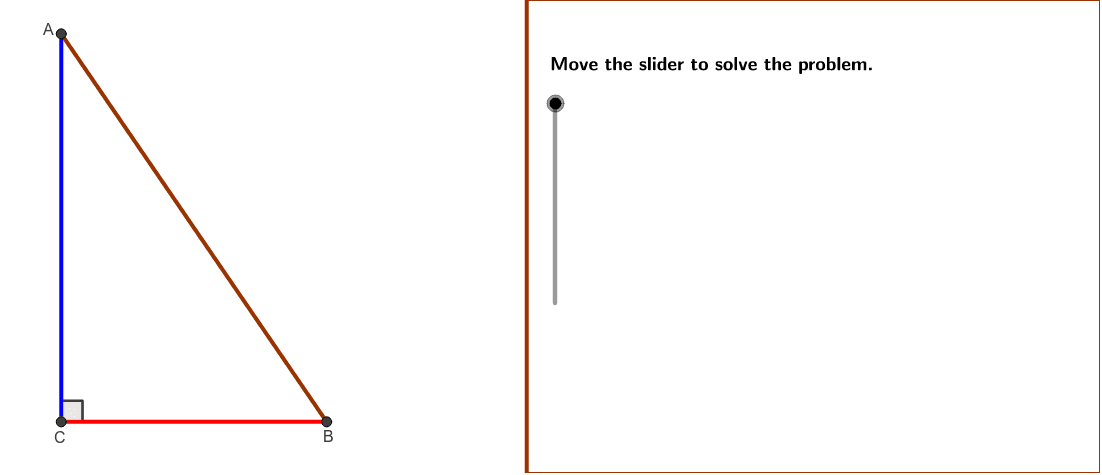
This example demonstrates how to solve a real-world shadow measurement problem using reciprocal functions and the Pythagorean Theorem. The math concepts involved include the application of trigonometric functions, the Pythagorean Theorem, and distance calculations. The construction uses commands like Polygon, Min, Segment, and Angle, along with objects such as distance, edge, and label in GeoGebra. It is suitable for high school students learning trigonometry and geometric constructions.
GeoGebra Commands & Parameters
Polygon((Edge, y(Corner[1])), Corner[2], Corner[3], (Edge, y(Corner[4]))) → Mask, a, b, c, dMin(5, (5 * distanceAC / distanceBC)) → lengthACSegment(C, A) → ACMin(5, (5 * distanceBC / distanceAC)) → lengthBCSegment(B, C) → BCSegment(B, A) → ABAngle(B, A, C) → BACAngle(A, C, B) → ACBAngle(C, B, A) → CBA
AI Drawing Prompt Reference
Draw a triangle with three vertices representing key positions in an egg incubator shadow problem. First, construct a rectangular mask based on given horizontal and vertical coordinates. Then, connect the three vertices to form the triangle, drawing all three sides. Add angle markers at each interior angle to indicate their measures. Finally, label the lengths of two sides with values calculated as the minimum of 5 and a ratio-based expression, representing possible shadow length limits. The figure should clearly show the triangle, angle annotations, and length constraints for trigonometric and Pythagorean analysis.
The prompt above was compiled from the original drawing commands and is for reference only.