
Effects of Scaling on Areas of Similar Figures
Loading the math board and drawing, please wait…
In collections
Perimeter & Area
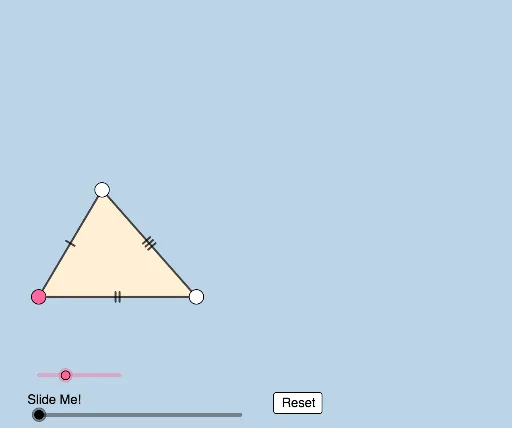
This example demonstrates the changes in area of similar figures when one figure is scaled up by a scale factor 'k'. Key math concepts include similarity transformation and area ratio relationships. The construction uses the Dilate command to create scaled figures and Polygon objects to visualize area changes. Suitable for high school students to understand properties of similar figures and ratio relationships, serving as an aid in geometric construction and transformation teaching.
GeoGebra Commands & Parameters
Rotate(B, (a * π / 180), A) → B'Angle(B, A, B') → αSegment(A, B) → fRay(A, B') → gPoint(g) → CSegment(A, C) → hSegment(C, B) → iLine(A, C) → jLine(C, B) → kLine(A, B) → lCircle(C, A) → cIntersect(c, j, 2) → DCircle(D, C) → dIntersect(d, j, 2) → ELine(D, i) → mLine(E, i) → nIntersect(l, m) → FIntersect(l, n) → GLine(C, l) → pLine(D, l) → qIntersect(m, p) → HIntersect(n, q) → ILine(B, H) → rLine(F, r) → sPolygon(A, B, C) → t1, c_1, a_1, bRotate(A, If[0 < e ≤ 1, (e * π), π], C) → A'Segment(C, A') → tRotate(A, If[1 < e ≤ 2, ((-(e - 1)) * π), (-π)], B) → A'_1Segment(B, A'_1) → f_1Dilate(C, If[2 < e ≤ 3, 3 - e, 0], D) → C'Vector(C, C') → uTranslate(C, u) → C'_1Translate(B, u) → B'_1Segment(C'_1, B'_1) → i'Dilate(B, If[3 < e ≤ 4, 4 - e, 0], F) → C'_2Vector(B, C'_2) → vTranslate(C, v) → C'_3Translate(B, v) → B'_2Segment(C'_3, B'_2) → i'_1Dilate(C, If[4 < e ≤ 5, 5 - e, 0], H) → C'_4Segment(C, C'_4) → g_1Dilate(B, If[4 < e ≤ 5, 5 - e, 0], H) → B'_3Segment(B, B'_3) → h_1Dilate(C, If[6 < e ≤ 7, 7 - e, 0], D) → C'_5Vector(C, C'_5) → wTranslate(A, w) → A'_2Translate(B, w) → B'_4Translate(C, w) → C'_6Polygon(A'_2, B'_4, C'_6) → t1', c'_6, a'_2, b'_4Dilate(D, If[7.75 < e ≤ 8.75, 8.75 - e, 0], H) → D'Vector(D, D') → u_1Translate(A'_2, u_1) → JTranslate(B'_4, u_1) → KTranslate(C'_6, u_1) → LPolygon(J, K, L) → t1'', l_1, j_1, k_1Midpoint(h_1) → MRotate(J, If[9.5 < e ≤ 10.5, ((e - 9.5) * π), π], M) → J'Rotate(K, If[9.5 < e ≤ 10.5, ((e - 9.5) * π), π], M) → K'Rotate(L, If[9.5 < e ≤ 10.5, ((e - 9.5) * π), π], M) → L'Polygon(J', K', L') → t1''', l', j', k'Rotate(C, If[13 < e ≤ 14, ((e - 13) * π), π], D) → C'_7Segment(D, C'_7) → i_1Midpoint(I, G) → NRotate(B, If[13 < e ≤ 14, ((-(e - 13)) * π), (-π)], F) → B'_5Segment(F, B'_5) → m_1Dilate(D, If[14 < e ≤ 15, 15 - e, 0], E) → D'_1Vector(D, D'_1) → v_1Translate(C'_1, v_1) → OTranslate(B'_1, v_1) → PSegment(O, P) → i''Translate(C'_3, v_1) → QTranslate(B'_2, v_1) → RSegment(Q, R) → n_1Dilate(F, If[15 < e ≤ 16, 16 - e, 0], G) → F'Vector(F, F') → w_1Translate(C'_3, w_1) → STranslate(B'_2, w_1) → TSegment(S, T) → p_1Dilate(H, If[16 < e ≤ 17, 17 - e, 0], N) → H'Dilate(H, If[16 < e ≤ 17, 17 - e, 0], I) → H'_1Dilate(D, If[16 < e ≤ 17, 17 - e, 0], I) → D'_2Dilate(F, If[16 < e ≤ 17, 17 - e, 0], N) → F'_1Segment(F, F'_1) → q_1Segment(H, H') → r_1Segment(H, H'_1) → s_1Segment(D, D'_2) → t_1Dilate(D, If[17.75 < e ≤ 18.75, 18.75 - e, 0], E) → D'_3Vector(D, D'_3) → b_1Dilate(F, If[17.75 < e ≤ 18.75, 18.75 - e, 0], G) → F'_2Vector(F, F'_2) → d_1Translate(A'_2, b_1) → UTranslate(B'_4, b_1) → VTranslate(C'_6, b_1) → WPolygon(U, V, W) → t1''_1, w_2, u_2, v_2Translate(J, d_1) → J'_1Translate(K, d_1) → K'_1Translate(L, d_1) → L'_1Polygon(J'_1, K'_1, L'_1) → t1'''_1, l'_1, j'_1, k'_1Dilate(N, If[19.5 < e ≤ 20.5, 20.5 - e, 0], I) → N'Vector(N, N') → e_1Translate(J'_1, e_1) → ZTranslate(K'_1, e_1) → A_1Translate(L'_1, e_1) → B_1Polygon(Z, A_1, B_1) → t2, b_2, z_1, a_2Midpoint(r_1) → C_1Rotate(Z, If[21.25 < e ≤ 22.25, ((e - 21.25) * π), π], C_1) → Z'Rotate(A_1, If[21.25 < e ≤ 22.25, ((e - 21.25) * π), π], C_1) → D_1Rotate(B_1, If[21.25 < e ≤ 22.25, ((e - 21.25) * π), π], C_1) → E_1Polygon(Z', D_1, E_1) → t2', e_2, z', d_2Dilate(C, If[23 < e ≤ 24, 24 - e, 0], D) → C'_8Vector(C, C'_8) → c_2Translate(J', c_2) → J''Translate(K', c_2) → K''Translate(L', c_2) → L''Polygon(J'', K'', L'') → t3, l'', j'', k''