
Effect of Coefficient b in Quadratic Functions
Loading the math board and drawing, please wait…
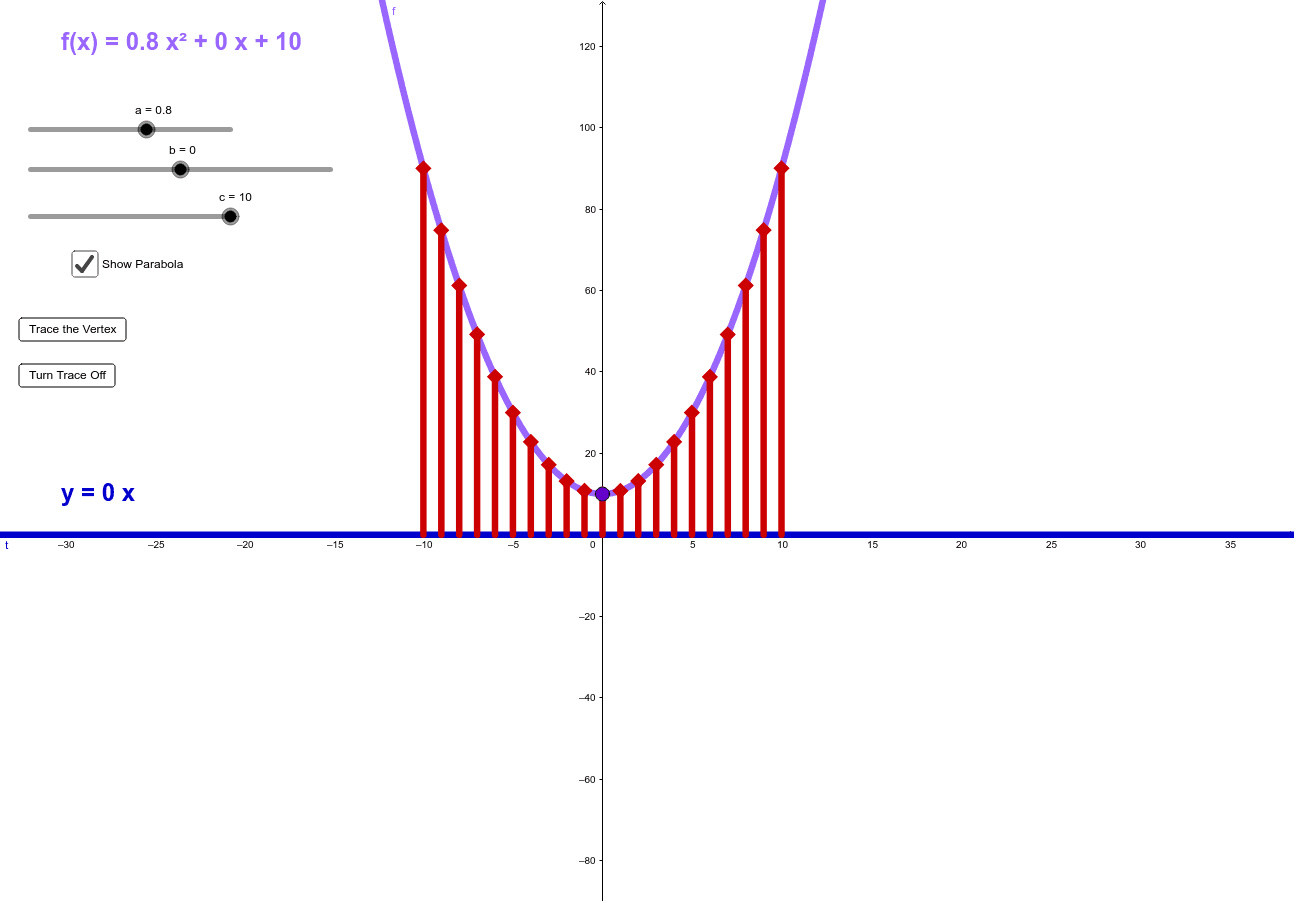
This interactive GeoGebra worksheet demonstrates the effect of the coefficient b in the quadratic function y = a x² + b x + c on the shape and position of the parabola. It shows how varying b shifts the parabola horizontally, moves the vertex, and changes the axis of symmetry. The construction uses the commands Intersect to find intersections with the axes, Segment to draw key line segments, and Sequence to generate a series of parabolas for different b values, with sliders for dynamic adjustment. Suitable for high school students studying quadratic functions and teachers preparing visual lessons on function transformations.
GeoGebra Commands & Parameters
Intersect(f, m, 1) → GIntersect(f, l, 1) → HIntersect(f, j, 1) → IIntersect(f, i, 1) → JIntersect(f, g, 1) → KIntersect(f, e, 1) → LIntersect(f, d, 1) → MIntersect(t, d) → AIntersect(t, e) → BIntersect(t, g) → CIntersect(t, j) → DIntersect(t, l) → EIntersect(t, m) → FSegment(A, M) → nSegment(B, L) → pSegment(C, K) → qSegment((0, 0), J) → rSegment(D, I) → sSegment(F, G) → a_1Segment(E, H) → c_3Sequence((a, f(a)), a, -10, 10) → list1Sequence(x = w, w, -10, 10) → list2Intersect(t, q_1, 1) → NIntersect(t, p_1, 1) → OIntersect(t, n_1, 1) → PIntersect(t, m_1, 1) → QIntersect(t, l_1, 1) → RIntersect(t, k_1, 1) → SIntersect(t, j_1, 1) → TIntersect(t, i_1, 1) → UIntersect(t, h_1, 1) → VIntersect(t, g_1) → WIntersect(t, f_1, 1) → ZIntersect(t, e_1, 1) → A_1Intersect(t, d_1, 1) → B_1Intersect(t, b_1, 1) → C_1Intersect(f, b_1, 1) → D_1Intersect(f, d_1, 1) → E_1Intersect(f, e_1, 1) → F_1Intersect(f, f_1, 1) → G_1Intersect(f, g_1, 1) → H_1Intersect(f, h_1, 1) → I_1Intersect(f, i_1, 1) → J_1Intersect(f, j_1, 1) → K_1Intersect(f, k_1, 1) → L_1Intersect(f, l_1, 1) → M_1Intersect(f, m_1, 1) → N_1Intersect(f, n_1, 1) → O_1Intersect(f, p_1, 1) → P_1Intersect(f, q_1, 1) → Q_1Segment(D_1, C_1) → r_1Segment(E_1, B_1) → s_1Segment(F_1, A_1) → t_1Segment(G_1, Z) → a_2Segment(H_1, W) → b_2Segment(V, I_1) → c_2Segment(U, J_1) → d_2Segment(K_1, T) → e_2Segment(L_1, S) → f_2Segment(M_1, R) → g_2Segment(Q, N_1) → h_2Segment(O_1, P) → i_2Segment(P_1, O) → j_2Segment(Q_1, N) → k_2