
Dynamic Triangle Phenomena Illustration
Loading the math board and drawing, please wait…
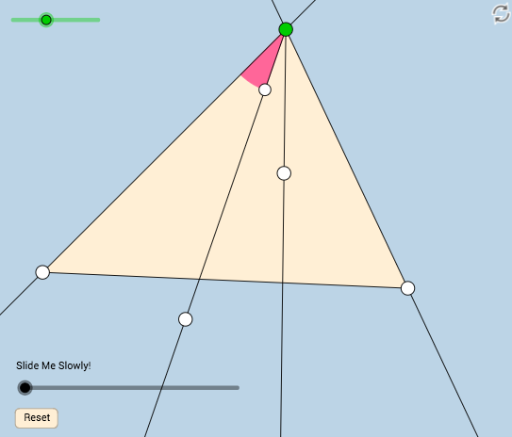
This example dynamically illustrates some cool phenomena within a triangle! ① It visually demonstrates geometric relationships and patterns in the triangle through dynamic manipulation. ② Core mathematical concepts include triangle properties, rational numbers, exponential functions, equilateral triangles, and optimization problems. ③ Construction highlights the use of GeoGebra commands/objects such as Rotate, Angle, Segment, Ray, Point, Intersect, Min, Circle, CircleArc, Mirror, Line, OrthogonalLine, Midpoint, Polygon, CircleSector, and Dilate. ④ Suitable for high school and above students to explore and understand complex geometric problems and function properties.
GeoGebra Commands & Parameters
Rotate(A, (a * π / 180), B) → A'Angle(A, B, A') → αSegment(B, A) → fRay(B, A') → gPoint(g) → CSegment(B, C) → hSegment(A, C) → iRotate(A, α / 2, B) → A'_1Angle(A, B, A'_1) → βRay(B, A'_1) → jIntersect(j, i) → DSegment(B, D) → kMin({f, h, k}) → bCircle(B, (0.25 * b)) → cIntersect(c, f, 1) → EIntersect(j, k) → FIntersect(c, h, 1) → GIntersect(c, j) → H,CircleArc(B, E, H) → dPoint(d) → IMirror(I, j) → I'Line(B, I') → lLine(B, I) → mRay(B, I') → nRay(B, I) → pPoint(p) → JLine(A, B) → qOrthogonalLine(J, q) → rIntersect(r, q) → KPoint(n) → LLine(B, C) → sOrthogonalLine(L, s) → tIntersect(s, t) → MOrthogonalLine(L, q) → eIntersect(q, e) → NOrthogonalLine(J, s) → f_1Intersect(s, f_1) → OMidpoint(J, L) → PCircle(P, K) → c_1Polygon(A, C, B) → poly1, b_1, a_1, c_2CircleSector(B, E, I) → d_1Angle(I, B, G) → γRotate(d_1, If[0 < o ≤ 1, (o * γ), γ], B) → e_1Angle(L, M, C) → δAngle(K, N, L) → εAngle(A, K, J) → ζAngle(J, O, C) → ηDilate(L, If[2 < o ≤ 3, 3 - o, 0], M) → L'Dilate(L, If[2 < o ≤ 3, 3 - o, 0], N) → L'_1Segment(L, L') → g_1Segment(L, L'_1) → h_1Dilate(J, If[3 < o ≤ 4, 4 - o, 0], O) → J'Dilate(J, If[3 < o ≤ 4, 4 - o, 0], K) → J'_1Segment(J, J') → i_1Segment(J, J'_1) → j_1Dilate(J, If[4 < o ≤ 5, 5 - o, 0], P) → J'_2Segment(J, J'_2) → k_1Dilate(P, If[5 < o ≤ 6, 6 - o, 0], L) → P'Segment(P, P') → l_1Rotate(J, If[6 < o ≤ 7, ((o - 6) * π), π], P) → J'_3Rotate(J'_2, If[6 < o ≤ 7, ((o - 6) * π), π], P) → QSegment(J'_3, Q) → m_1Dilate(P, If[7 < o ≤ 8, 8 - o, 0], N) → P'_1Segment(P, P'_1) → n_1Circle(P, P'_1) → p_1