
Dynamic Relationship Between Incircle and Triangle
Loading the math board and drawing, please wait…
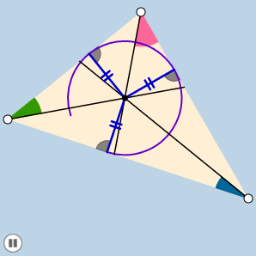
This example demonstrates the dynamic relationship between a triangle's incircle, angles, and side lengths through animation. Core concepts include incircle, angles, slope, statistical characteristics, and quadratic equations. It utilizes commands like Line, Slope, PointIn, Angle, Segment, Min, Circle, Intersect, Incircle, Center, Polygon, Rotate, Ray, CircleSector, Dilate, OrthogonalLine, CircleArc for construction. Suitable for high school mathematics education, combining geometric construction with statistical distributions.
GeoGebra Commands & Parameters
Line(A, B) → dSlope(d) → aPointIn(c) → CLine(A, C) → eLine(B, C) → fAngle(B, A, C) → αAngle(A, C, B) → βAngle(C, B, A) → γSegment(A, C) → gSegment(C, B) → hSegment(B, A) → iMin(list1) → jCircle(C, (0.2 * j)) → qCircle(A, (0.2 * j)) → pCircle(B, (0.2 * j)) → kIntersect(q, f, 2) → DIntersect(q, e, 1) → EIntersect(q, e, 2) → FIntersect(p, e, 2) → GIntersect(p, d, 1) → HIntersect(k, f, 2) → I_2Intersect(k, d, 2) → JIntersect(d, i) → KIntersect(d, i) → LIntersect(k, f, 1) → NIntersect(p, e, 1) → OIntersect(p, d, 2) → PAngle(D, C, E) → δAngle(O, A, P) → εAngle(J, B, I_2) → ηAngle(G, A, H) → θIncircle(A, B, C) → rCenter(r) → ILine(C, I) → lLine(A, I) → nLine(B, I) → sIntersect(e, s) → RIntersect(d, l) → SIntersect(f, n) → TPolygon(A, B, C) → poly1, c_1, a_1, b_1Rotate(D, δ / 2, C) → D'Angle(D, C, D') → κRotate(J, η / 2, B) → J'Angle(J, B, J') → λRay(C, D') → tRay(B, J') → e_1Rotate(O, ε / 2, A) → O'Angle(O, A, O') → ιRay(A, O') → d_1Segment(C, S) → f_1Segment(A, T) → g_1Segment(B, R) → h_1Intersect(q, f_1, 1) → UIntersect(q, f, 1) → VIntersect(p, g_1, 1) → WIntersect(k, h_1, 1) → ZCircleSector(C, E, U) → k_1CircleSector(A, P, W) → q_1CircleSector(B, I_2, Z) → p_1Dilate(C, If[0 < m ≤ 1, 1 - m, 0], S) → C'Segment(C, C') → i_1Rotate(k_1, If[1 < m ≤ 2, ((m - 1) * β / 2), β / 2], C) → r_1Dilate(B, If[2 < m ≤ 3, 3 - m, 0], R) → B'Segment(B, B') → j_1Rotate(p_1, If[3 < m ≤ 4, ((m - 3) * γ / 2), γ / 2], B) → s_1Dilate(A, If[4 < m ≤ 5, 5 - m, 0], T) → A'Segment(A, A') → l_1Rotate(q_1, If[5 < m ≤ 6, ((m - 5) * α / 2), α / 2], A) → t_1OrthogonalLine(I, f) → m_1OrthogonalLine(I, d) → n_1OrthogonalLine(I, e) → a_2Intersect(f, m_1) → MIntersect(d, n_1) → A_1Intersect(e, a_2) → B_1Segment(I, M) → b_2Circle(M, (0.2 * b_2)) → c_2Intersect(c_2, f, 1) → C_1Intersect(c_2, b_2, 1) → D_1Intersect(c_2, f, 2) → E_1CircleSector(M, E_1, D_1) → d_2Dilate(I, If[6 < m ≤ 7, 7 - m, 0], M) → Q'Segment(I, Q') → e_2Rotate(d_2, If[7.5 < m ≤ 8.5, ((m - 7.5) * π / 2), 1.5707963267948966], M) → f_2Segment(I, B_1) → g_2Segment(I, A_1) → h_2Circle(B_1, (0.2 * g_2)) → k_2Circle(A_1, (0.2 * h_2)) → p_2Intersect(k_2, e, 2) → F_1Intersect(k_2, g_2, 1) → G_1Intersect(k_2, e, 1) → H_1Intersect(p_2, d, 2) → I_1Intersect(p_2, h_2, 1) → J_1Intersect(p_2, d, 1) → K_1Dilate(I, If[8.5 < m ≤ 9.5, 9.5 - m, 0], B_1) → Q'_1Segment(I, Q'_1) → i_2CircleSector(B_1, H_1, G_1) → q_2CircleSector(A_1, I_1, J_1) → r_2Rotate(q_2, If[10 < m ≤ 11, ((m - 10) * π / 2), 1.5707963267948966], B_1) → s_2Dilate(I, If[11 < m ≤ 12, 12 - m, 0], A_1) → Q'_2Segment(I, Q'_2) → j_2Rotate(r_2, If[12.5 < m ≤ 13.5, ((m - 12.5) * π / 2), 1.5708], A_1) → t_2Angle(M, I, B_1) → ζAngle(B_1, I, A_1) → μAngle(A_1, I, M) → νRotate(I, If[14 < m ≤ 15, ((m - 14) * ζ), ζ], I) → Q'_3Rotate(Q', If[14 < m ≤ 15, ((m - 14) * ζ), ζ], I) → Q''Segment(Q'_3, Q'') → l_2Rotate(Q'_3, If[15 < m ≤ 16, ((m - 15) * μ), μ], I) → L_1Rotate(Q'', If[15 < m ≤ 16, ((m - 15) * μ), μ], I) → Q'''Segment(L_1, Q''') → m_2Rotate(A_1, If[16 < m ≤ 18, ((m - 16) * π), 6.28319], I) → M'Intersect(m_1, f) → QCircle(I, Q) → d_3Line(A, B) → n_2CircleArc(I, A_1, M') → c_3