
Dynamic Proof of Trapezoid Area as Two Triangles
Loading the math board and drawing, please wait…
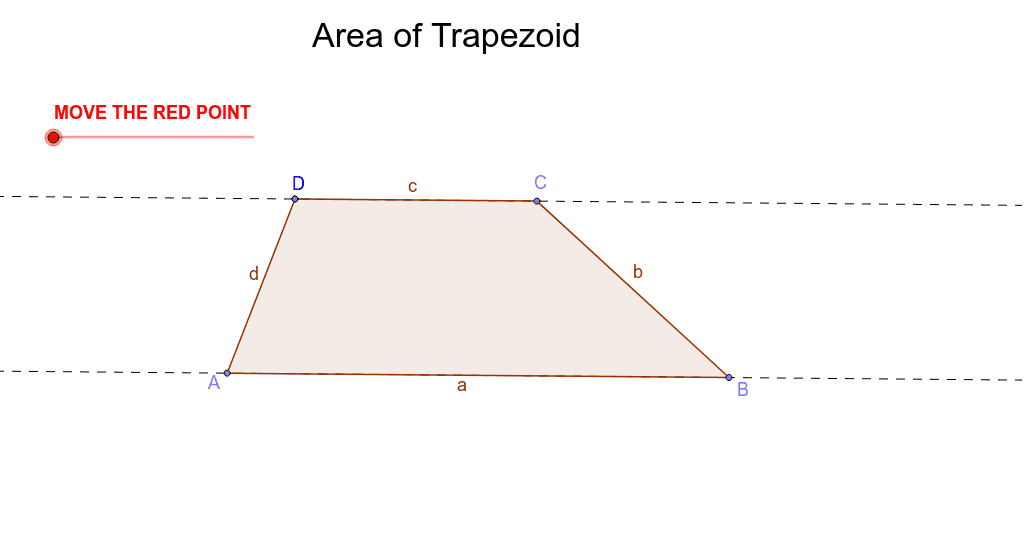
This example dynamically demonstrates the formula for the area of a trapezoid by dividing it into two triangles. It involves core mathematical concepts such as trapezoid area, triangle area, and dynamic geometric proof. The construction uses GeoGebra commands like Vector, Line, Point, Polygon, OrthogonalLine, Intersect, and Segment. Suitable for high school mathematics education to understand the geometric basis of the trapezoid area formula and enhance spatial reasoning.
GeoGebra Commands & Parameters
Vector(J, K) → uLine(A, B) → aLine(C, a) → bPoint(a) → DPoint(a) → EPoint(b) → GPoint(C, u) → FPolygon(D, E, G, F) → mnohoúhelník1, d, e, g, fOrthogonalLine(D, b) → cOrthogonalLine(G, a) → hIntersect(b, c) → HIntersect(h, a) → ISegment(D, H) → iSegment(G, I) → kPolygon(D, G, F) → mnohoúhelník2, f_1, d_1, g_1Polygon(D, E, G) → mnohoúhelník3, g_2, d_2, e_1Polygon(D, E, G, F) → mnohoúhelník4, d_3, e_2, g_3, f_2
AI Drawing Prompt Reference
Draw a trapezoid with a horizontal bottom base and a shorter parallel top base. From the two endpoints of the bottom base, draw perpendicular lines upward to meet the top base, marking the foot points. Connect these foot points to form the top base. Then draw a diagonal from one bottom vertex to the opposite top vertex, splitting the trapezoid into two triangles. In each triangle, draw the altitude from the diagonal's endpoints to the opposite side. Finally, shade or color the two triangles differently to show that the trapezoid area equals the sum of the two triangle areas.
The prompt above was compiled from the original drawing commands and is for reference only.