
Dynamic Inequalities in a Triangle
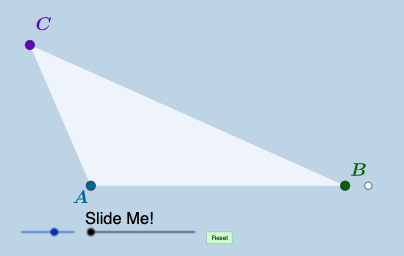
Loading the math board and drawing, please wait…
This example dynamically demonstrates inequalities within a triangle. It covers core math concepts like inequalities, triangle properties, and side-angle relationships. Construction involves GeoGebra commands such as Ray, Rotate, Angle, Point, Segment, Midpoint, Min, Circle, Intersect, CircleSector, Polygon, Dilate, Vector, Translate, and CircleArc. Suitable for high school mathematics education to visually understand triangle inequality theorems and dynamic variations.
GeoGebra Commands & Parameters
Ray(A, B_1) → fRotate(B_1, (a_2 * pi / 180), A) → B'Angle(B_1, A, B') → αRay(A, B') → gPoint(g) → CPoint(f) → BSegment(C, B) → hMidpoint(h) → EMidpoint(C, A) → FMidpoint(B, A) → GSegment(A, B) → iSegment(A, C) → jMin({i, h, j}) → b_1Circle(A, (0.2 * b_1)) → c_2Circle(C, (0.2 * b_1)) → dCircle(B, (0.2 * b_1)) → eIntersect(d, j, 1) → HIntersect(d, h, 1) → IIntersect(c_2, j, 1) → JIntersect(c_2, i, 1) → KIntersect(e, i, 1) → LIntersect(e, h, 1) → MCircleSector(A, K, J) → kCircleSector(B, M, L) → pCircleSector(C, H, I) → qPolygon(A, B, C) → poly1, c_1, a_1, d_1Rotate(K, If[0 < l ≤ 1, (l * α), α], A) → K'CircleSector(A, K, K') → rDilate(B, If[1 < l ≤ 2, 2 - l, 0], C) → D'Segment(B, D') → aDilate(A, If[2.5 < l ≤ 3.5, 3.5 - l, 0], E) → A'Vector(A, A') → uTranslate(r, u) → r'Angle(M, B, L) → βRotate(M, If[3.5 < l ≤ 4.5, ((l - 3.5) * β), β], B) → M'CircleSector(B, M, M') → sDilate(A, If[4.5 < l ≤ 5.5, 5.5 - l, 0], C) → A'_1Segment(A, A'_1) → bDilate(B, If[6 < l ≤ 7, 7 - l, 0], F) → D'_1Vector(B, D'_1) → vTranslate(s, v) → s'Rotate(H, If[7 < l ≤ 8, ((l - 7) * (pi - α - β)), pi - α - β], C) → H'CircleSector(C, H, H') → tDilate(B, If[8 < l ≤ 9, 9 - l, 0], A) → D'_2Segment(B, D'_2) → cDilate(C, If[9.5 < l ≤ 10.5, 10.5 - l, 0], G) → C'Vector(C, C') → wTranslate(t, w) → t'CircleArc(A, K, J) → e_1CircleArc(B, M, L) → g_1CircleArc(C, H, I) → h_1
AI Drawing Prompt Reference
Draw a triangle ABC with vertices A, B, and C. First, draw the sides AB, BC, and CA. Then, construct the midpoints E, F, and G of sides AB, BC, and CA, and the perpendicular bisectors of these sides. Next, draw circles centered at A, B, and C with radii 0.2 times the side lengths, and find their intersections with the perpendicular bisectors to get points H, I, J, K, L, M, and N. Use these points to construct arcs k, p, and q, forming the incircle of the triangle. Finally, use rotation and scaling operations to dynamically show how changes in side lengths affect the incircle.
The prompt above was compiled from the original drawing commands and is for reference only.