
Dynamic Incircle and Excircle Relationship
Loading the math board and drawing, please wait…
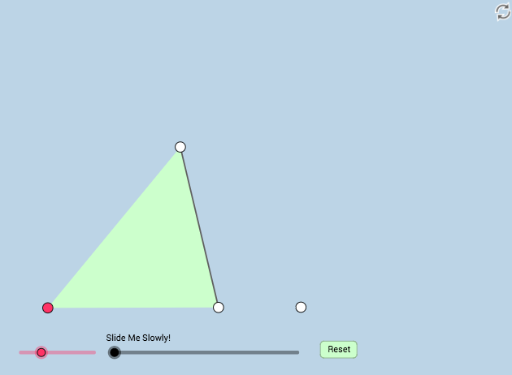
This example dynamically illustrates the relationship between a triangle's incircle and one of its excircles. It involves core mathematical concepts such as circles, triangles, angles, and geometric transformations. The construction utilizes commands like Rotate, Ray, Point, Segment, Min, Angle, Circle, Intersect, CircleSector, OrthogonalLine, Midpoint, Polygon, Dilate, CircleArc, Vector, Translate, and Line. It is suitable for high school and above students to understand the geometric properties and dynamic relationships between triangles and circles.
GeoGebra Commands & Parameters
Rotate(B, (a * π / 180), A) → B'Ray(A, B') → gPoint(g) → CSegment(A, C) → jRay(A, B) → fPoint(f) → DSegment(C, D) → hSegment(A, D) → iMin({i, j, h}) → bAngle(B, A, B') → αCircle(D, (0.2 * b)) → dCircle(C, 4) → cIntersect(c, g, 2) → EIntersect(d, f, 2) → FRay(D, F) → kRay(C, E) → lCircle(C, (0.2 * b)) → eCircle(D, (0.15 * b)) → pAngle(F, D, C) → βAngle(D, C, E) → γRotate(F, β / 2, D) → F'Angle(F, D, F') → δRotate(D, γ / 2, C) → D'Angle(D, C, D') → εRay(C, D') → mRay(D, F') → nIntersect(e, m, 1) → GIntersect(e, h, 1) → HIntersect(p, h, 1) → ICircleSector(C, H, G) → qCircleSector(D, F, F') → rIntersect(m, n) → JOrthogonalLine(J, k) → sOrthogonalLine(J, l) → tIntersect(s, k) → KIntersect(t, l) → LCircle(J, K) → c_1Segment(L, K) → f_1Midpoint(f_1) → MOrthogonalLine(M, f_1) → g_1Intersect(c_1, g_1, 2) → NSegment(N, C) → h_1Segment(N, D) → i_1Polygon(A, D, C) → poly1, c_2, a_1, d_2Angle(J, K, D) → ζAngle(C, L, J) → ηDilate(A, If[0 < o ≤ 1, 1 - o, 0], D) → A'Dilate(A, If[0 < o ≤ 1, 1 - o, 0], C) → A'_1Segment(A, A') → k_1Segment(A, A'_1) → l_1Dilate(C, If[1 < o ≤ 2, 2 - o, 0], J) → C'Dilate(D, If[1 < o ≤ 2, 2 - o, 0], J) → D'_1Segment(C, C') → m_1Segment(D, D'_1) → n_1Rotate(r, If[2.5 < o ≤ 3.5, ((o - 2.5) * δ), δ], D) → r'Rotate(q, If[3.5 < o ≤ 4.5, ((o - 3.5) * ε), ε], C) → q'Dilate(J, If[5 < o ≤ 6, 6 - o, 0], L) → J'Dilate(J, If[5 < o ≤ 6, 6 - o, 0], K) → J'_1Segment(J, J'_1) → p_1Segment(J, J') → q_1Angle(L, J, K) → θRotate(L, If[6 < o ≤ 7, ((o - 6) * θ), θ], J) → L'CircleArc(J, L, L') → e_1Rotate(K, If[7 < o ≤ 8, ((o - 7) * ((2 * π) - θ) / 2), ((2 * π) - θ) / 2], J) → K'CircleArc(J, K, K') → r_1Rotate(N, If[8 < o ≤ 9, ((o - 8) * ((2 * π) - θ) / 2), ((2 * π) - θ) / 2], J) → N'CircleArc(J, N, N') → s_1Dilate(N, If[11 < o ≤ 12, 12 - o, 0], D) → N'_1Dilate(N, If[11 < o ≤ 12, 12 - o, 0], C) → N'_2Min(c_2, d_2) → wCircle(A, (0.15 * w)) → e_2Segment(A, C) → m_2Intersect(e_2, m_2) → S,Segment(A, D) → n_2Intersect(e_2, n_2) → T,Min({h, k_1, l_1}) → b_1Intersect(d, h, 1) → UIntersect(e, h) → W,Angle(A, C, D) → λAngle(C, D, A) → κRotate(A, λ / 2, C) → A'_2Angle(A, C, A'_2) → ιRay(C, A'_2) → t_1Rotate(C, κ / 2, D) → C'_1Angle(C, D, C'_1) → μ_1Ray(D, C'_1) → f_2Intersect(d, f_2) → A_1,CircleSector(D, U, A_1) → r_2Intersect(t_1, f_2) → ZOrthogonalLine(Z, k_1) → s_2OrthogonalLine(Z, l_1) → t_2Intersect(s_2, k_1) → B_1Intersect(t_2, l_1) → C_1Intersect(k_1, t_1) → D_1Circle(A, (0.2 * b)) → q_2Angle(D, A, C) → μRotate(D, μ / 2, A) → D'_2Angle(D, A, D'_2) → νRay(A, D'_2) → a_2Intersect(q_2, a_2) → V,Intersect(q_2, k_1) → E_1,CircleSector(A, E_1, V) → p_2Dilate(D, If[1 < o ≤ 2, 2 - o, 0], Z) → D'_3Dilate(A, If[1 < o ≤ 2, 2 - o, 0], Z) → A'_3Segment(A, A'_3) → b_2Segment(D, D'_3) → f_3Rotate(r_2, If[2.5 < o ≤ 3.5, ((o - 2.5) * κ / 2), κ / 2], D) → c_3Rotate(p_2, If[3.5 < o ≤ 4.5, ((o - 3.5) * μ / 2), μ / 2], A) → d_3Dilate(Z, If[5 < o ≤ 6, 6 - o, 0], C_1) → Z'Dilate(Z, If[5 < o ≤ 6, 6 - o, 0], B_1) → Z'_1Segment(Z, Z') → g_3Segment(Z, Z'_1) → h_3Angle(Z, B_1, A) → ξAngle(A, C_1, Z) → οCircle(Z, Z') → e_3Rotate(C_1, If[6 < o ≤ 9, (((o - 6) * 2) * π / 3), (2 * π)], Z) → F_1Segment(C, D_1) → i_3Intersect(e, i_3) → G_1,Intersect(e, l_1) → H_1,Dilate(C, If[9.5 < o ≤ 10.5, 10.5 - o, 0], Z) → C'_2Dilate(J, If[9.5 < o ≤ 10.5, 10.5 - o, 0], Z) → J'_2Segment(J, J'_2) → j_1Segment(C, C'_2) → d_1CircleSector(C, H_1, G_1) → g_2Polygon(A, Z, C) → poly2, c_4, a_3, z_1Polygon(A, D, J) → poly3, j_2, a_4, d_4CircleArc(A, E_1, V) → h_2CircleArc(Z, Z', F_1) → k_3Dilate(C, If[11 < o ≤ 12, 12 - o, 0], J) → C'_3Vector(C, C'_3) → u_1Translate(g_2, u_1) → k_2Line(C, j_1) → i_2Point(i_2) → OAngle(O, C, H_1) → ρRotate(k_2, If[12 < o ≤ 13, ((-(o - 12)) * ρ), (-ρ)], J) → p_3
AI Drawing Prompt Reference
Draw a triangle and dynamically illustrate the relationship between its incircle and one of its excircles. Start by drawing a side of the triangle, then find the midpoint of this side and draw an incircle centered at this point. Next, draw an excircle centered at the midpoint of the side opposite the triangle's vertex, with the radius equal to the distance from the midpoint to the vertex. Connect the intersection points of the incircle and excircle to show the dynamic geometric relationship.
The prompt above was compiled from the original drawing commands and is for reference only.