
Dynamic Illustration of Concyclic Relationship Between Two Circles and Their Com
Loading the math board and drawing, please wait…
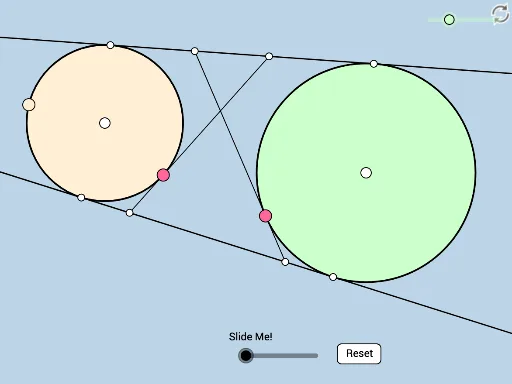
This example demonstrates the concyclic relationship between two circles and their common external tangents. Key mathematical concepts include circles, tangents, and concyclic points. The construction uses GeoGebra commands such as Circle, Tangent, Intersect, etc. Suitable for students at the junior high school level and above to learn about circle properties and concyclic points.
GeoGebra Commands & Parameters
Circle(A, B) → cSegment(A, B) → fPointIn(a) → CDistance(C, c) → bCircle(C, d) → eTangent(c, e) → g, h, i, jIntersect(c, h) → DIntersect(e, h) → G, LIntersect(e, g) → H, KIntersect(e, i) → IIntersect(c, i) → J, MIntersect(c, g) → OCircle(D, 2) → pCircle(O, 2) → rCircle(K, 2) → sCircle(I, 2) → tCircle(G, 2) → d_1Circle(J, 2) → e_1Intersect(e_1, i, 1) → PIntersect(e_1, i, 2) → QIntersect(p, h, 1) → RIntersect(p, h, 2) → SIntersect(d_1, h, 1) → VIntersect(d_1, h, 2) → WIntersect(s, g, 2) → ZIntersect(s, g, 1) → A_1Intersect(r, g, 2) → B_1Intersect(r, g, 1) → C_1Dilate(A, If[0 < k ≤ 1, 1 - k, 0], D) → A'Dilate(A, If[0 < k ≤ 1, 1 - k, 0], M) → A'_1Dilate(A, If[0 < k ≤ 1, 1 - k, 0], O) → A'_3Angle(A, O, C_1) → αAngle(A, D, S) → δIntersect(t, i, 1) → F_1Angle(C, I, F_1) → ζAngle(C, G, W) → θ_1Dilate(C, If[0 < k ≤ 1, 1 - k, 0], G) → C'Dilate(C, If[0 < k ≤ 1, 1 - k, 0], I) → C'_2Dilate(C, If[0 < k ≤ 1, 1 - k, 0], K) → C'_3Intersect(i, j) → G_1Intersect(i, j) → H_1Line(C, H) → k_1Intersect(e, ee) → J_1, , ,Dilate(H, If[8 < k ≤ 9, 9 - k, 0], C) → H'_1Vector(H, H'_1) → wDilate(H, If[11 < k ≤ 12, 12 - k, 0], C) → H'_2Vector(H, H'_2) → u_1Segment(A, B) → h_2Intersect(e, ee, 1) → W_1CircleArc(A, O, D) → k_2CircleArc(C, G, H) → p_2Point(k_2) → Z_1Point(p_2) → A_2Segment(A, Z_1) → i_2Segment(C, A_2) → j_2OrthogonalLine(Z_1, i_2) → l_2OrthogonalLine(A_2, j_2) → m_2Line(D, Z_1) → lLine(G, A_2) → mIntersect(h, m_2) → EIntersect(g, m_2) → FIntersect(l_2, h) → NIntersect(g, l_2) → TIntersect(m, l) → ULine(H, A_2) → nLine(O, Z_1) → qIntersect(n, q) → D_1Circle(A_2, D_1, Z_1) → c_1Segment(F, E) → f_1Segment(T, N) → g_1LineBisector(A_2, D_1) → h_1LineBisector(D_1, Z_1) → i_1Intersect(h_1, i_1) → E_1Dilate(D, If[0 < k ≤ 1, 1 - k, 0], U) → D'Segment(D, D') → j_1Dilate(G, If[0 < k ≤ 1, 1 - k, 0], U) → G'Segment(G, G') → l_1Dilate(H, If[1 < k ≤ 2, 2 - k, 0], D_1) → H'Dilate(O, If[1 < k ≤ 2, 2 - k, 0], D_1) → O'Segment(O, O') → m_1Segment(H, H') → n_1Dilate(E_1, If[3 < k ≤ 4, 4 - k, 0], U) → I_1Circle(E_1, I_1) → p_1