
Dynamic Geometry Proof Demonstration
Loading the math board and drawing, please wait…
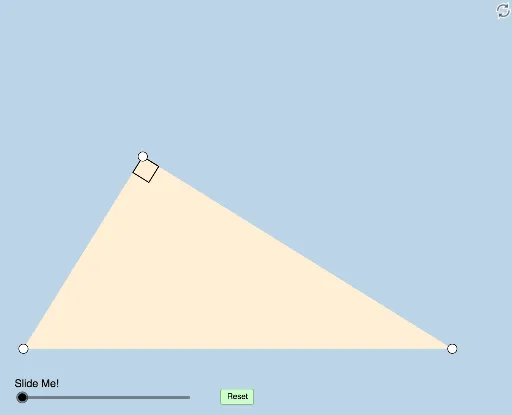
This example dynamically illustrates geometric relationships between parallelograms and triangles, along with volume calculations. Core concepts include parallelogram properties, triangle area, solid geometry volume, and conditional probability. Construction highlights the use of GeoGebra commands like Circle, Semicircle, Point, Midpoint, Segment, OrthogonalLine, Intersect, Polygon, Angle, Dilate, Rotate, Ray, Vector, and Translate. Suitable for high school students and teachers for geometric proof and spatial reasoning development.
GeoGebra Commands & Parameters
Circle(A, B) → cSemicircle(A, B) → dPoint(d) → CMidpoint(A, B) → FSegment(A, C) → fSegment(C, B) → gSegment(B, A) → hPoint(f) → DPoint(g) → EMidpoint(D, E) → GSegment(F, G) → iSegment(A, D) → jOrthogonalLine(E, g) → kCircle(E, j) → eIntersect(e, k) → H, ISegment(E, I) → lMidpoint(B, I) → JSegment(B, J) → mPolygon(A, B, C) → poly1, c_1, a, bAngle(A, C, B) → αDilate(A, If[0 < n ≤ 1, 1 - n, 0], F) → A'Segment(A, A') → pRotate(A, If[1 < n ≤ 2, ((-(n - 1)) * π), (-π)], F) → A'_1Rotate(A', If[1 < n ≤ 2, ((-(n - 1)) * π), (-π)], F) → A''Segment(A'_1, A'') → p'Dilate(D, If[3 < n ≤ 4, 4 - n, 0], G) → D'Segment(D, D') → qDilate(G, If[4 < n ≤ 5, 5 - n, 0], E) → G'Segment(G, G') → rRotate(D, If[5 < n ≤ 6, ((-(n - 5)) * π), (-π)], G) → D'_1Rotate(D', If[5 < n ≤ 6, ((-(n - 5)) * π), (-π)], G) → D''Segment(D'_1, D'') → q'Angle(B, E, I) → βDilate(A, If[6 < n ≤ 7, 7 - n, 0], D) → A'_2Dilate(B, If[6 < n ≤ 7, 7 - n, 0], E) → B'Segment(A, A'_2) → sSegment(B, B') → tRotate(B, If[7 < n ≤ 8, ((n - 7) * π / 2), π / 2], E) → B'_1Rotate(B', If[7 < n ≤ 8, ((n - 7) * π / 2), π / 2], E) → B''Segment(B'_1, B'') → t'Circle(I, 2) → d_1Intersect(d_1, k, 2) → KRay(I, K) → f_1Dilate(A, If[8 < n ≤ 9, 9 - n, 0], E) → A'_3Vector(A, A'_3) → uTranslate(A, u) → A'_4Translate(A'_2, u) → LSegment(A'_4, L) → s'Dilate(I, If[9 < n ≤ 10, 10 - n, 0], J) → I'Segment(I, I') → g_1Dilate(J, If[10 < n ≤ 11, 11 - n, 0], B) → J'Segment(J, J') → h_1Rotate(I, If[11 < n ≤ 12, ((n - 11) * π), π], J) → I'_1Rotate(I', If[11 < n ≤ 12, ((n - 11) * π), π], J) → I''Segment(I'_1, I'') → i_1Polygon(E, B, I) → poly2, i_2, e_1, b_1Dilate(F, If[12 < n ≤ 13, 13 - n, 0], G) → F'Segment(F, F') → j_1Dilate(B, If[13 < n ≤ 14, 14 - n, 0], F) → B'_2Vector(B, B'_2) → vTranslate(I'_1, v) → MTranslate(I'', v) → I'''Segment(M, I''') → k_1
AI Drawing Prompt Reference
Draw a dynamic geometric illustration showing relationships between parallelograms and triangles, including volume calculations. Start by creating a circle and semicircle, then determine points and line segments, finding midpoints and perpendicular lines. Next, use dilation and rotation to form parallelograms and triangles, calculating their areas and volumes. Finally, demonstrate geometric transformations and spatial reasoning with vectors and translations.
The prompt above was compiled from the original drawing commands and is for reference only.