
Dynamic Geometry Illustration by Tim Brzezinski (8)
Loading the math board and drawing, please wait…
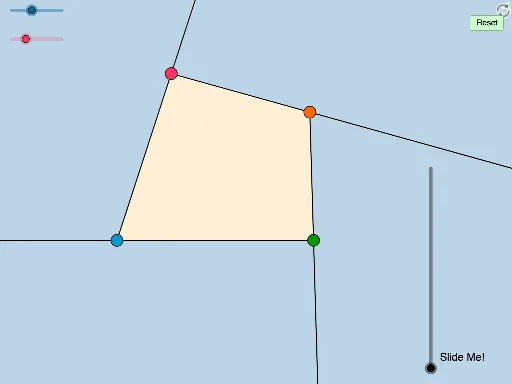
This example dynamically demonstrates a geometry problem posted by Antonio Gutierrez, visually showcasing the application of trigonometry, combinatorics, and coordinate geometry. The illustration utilizes GeoGebra commands and objects such as Rotate, Angle, Ray, Segment, Point, Min, Circle, Intersect, CircleSector, Line, Dilate, Vector, Polygon, and LineBisector, making it suitable for high school and above students to explore complex geometric constructions.
GeoGebra Commands & Parameters
Rotate(A, (a * π / 180), B) → A'Angle(A, B, A') → αRay(B, A') → fSegment(B, A) → gPoint(f) → CAngle(B, C, A) → βRotate(B, γ, C) → B'Angle(B, C, B') → δRay(C, B') → hPoint(h) → DRay(D, A) → iSegment(A, B) → jSegment(B, C) → kSegment(C, D) → lSegment(D, A) → mMin({j, k, l, m}) → bRay(A, B) → nRay(B, C) → pCircle(B, (0.25 * b)) → cIntersect(c, n, 2) → EIntersect(c, p, 1) → FCircle(C, (0.25 * b)) → dCircle(D, (0.25 * b)) → eCircle(A, (0.25 * b)) → qIntersect(d, h, 1) → GIntersect(d, p, 2) → HIntersect(e, i, 1) → IIntersect(e, h, 2) → JIntersect(q, n, 1) → KIntersect(q, i, 2) → LCircleSector(B, F, E) → rCircleSector(C, G, H) → sCircleSector(D, I, J) → tCircleSector(A, K, L) → c_1Angle(C, D, A) → εLine(B, A) → f_1Dilate(A, If[0 < u ≤ 1, 1 - u, 0], B) → A'_1Vector(A, A'_1) → vDilate(B, If[1 < u ≤ 2, 2 - u, 0], C) → B'_1Vector(B, B'_1) → wDilate(C, If[2 < u ≤ 3, 3 - u, 0], D) → C'Vector(C, C') → u_1Polygon(B, A, D, C) → poly1, b_1, a_1, d_2, c_2Circle(B, 10) → h_1Circle(A, 5) → k_1Circle(C, 5) → p_1Circle(D, 5) → q_1Intersect(h_1, n) → M, NIntersect(p_1, p) → O, PIntersect(q_1, h) → Q, RIntersect(k_1, i) → S, TRotate(C, (π - α) / 2, B) → C'_1Angle(C, B, C'_1) → ζRotate(P, ((-(π - δ))) / 2, C) → P'Angle(P, C, P') → ηRotate(A, (π - ε) / 2, D) → A'_2Angle(A, D, A'_2) → θ_1Angle(B, A, T) → θRotate(T, (-((π - θ) / 2)), A) → T'Line(B, C'_1) → j_1Line(C, P') → l_1Line(D, A'_2) → m_1Intersect(j_1, l_1) → VIntersect(l_1, m_1) → WRotate(B, θ / 2, A) → B'_2Angle(B, A, B'_2) → ιRay(A, B'_2) → i_1Intersect(j_1, i_1) → ULineBisector(V, U) → n_1Line(A, U) → r_1Intersect(m_1, r_1) → ZCircle(U, V, W) → s_1LineBisector(V, W) → t_1LineBisector(Z, W) → f_2Intersect(t_1, f_2) → A_1Dilate(B, If[0 < u ≤ 1, 1 - u, 0], V) → B'_3Dilate(C, If[0 < u ≤ 1, 1 - u, 0], W) → C'_2Dilate(D, If[0 < u ≤ 1, 1 - u, 0], Z) → D'Dilate(A, If[0 < u ≤ 1, 1 - u, 0], U) → A'_3Segment(B, B'_3) → g_1Segment(C, C'_2) → d_1Segment(D, D') → e_1Segment(A, A'_3) → g_2Rotate(F, If[1 < u ≤ 2, ((u - 1) * ζ), ζ], B) → F'Rotate(G, If[1 < u ≤ 2, ((u - 1) * (π - δ) / 2), (π - δ) / 2], C) → G'Rotate(I, If[1 < u ≤ 2, ((u - 1) * θ_1), θ_1], D) → I'Rotate(K, If[1 < u ≤ 2, ((u - 1) * θ / 2), θ / 2], A) → K'CircleSector(B, F, F') → e_2CircleSector(C, G, G') → h_2CircleSector(D, I, I') → k_2CircleSector(A, K, K') → p_2Dilate(C, If[2 < u ≤ 3, 3 - u, 0], V) → C'_3Dilate(D, If[2 < u ≤ 3, 3 - u, 0], W) → D'_1Dilate(A, If[2 < u ≤ 3, 3 - u, 0], Z) → A'_4Dilate(B, If[2 < u ≤ 3, 3 - u, 0], U) → B'_4Segment(C, C'_3) → i_2Segment(D, D'_1) → j_2Segment(A, A'_4) → l_2Segment(B, B'_4) → m_2Rotate(e_2, If[3 < u ≤ 4, ((u - 3) * ζ), ζ], B) → q_2Rotate(h_2, If[3 < u ≤ 4, ((u - 3) * (π - δ) / 2), (π - δ) / 2], C) → r_2Rotate(k_2, If[3 < u ≤ 4, ((u - 3) * θ_1), θ_1], D) → s_2Rotate(p_2, If[3 < u ≤ 4, ((u - 3) * θ / 2), θ / 2], A) → t_2Dilate(A_1, If[5 < u ≤ 6, 6 - u, 0], V) → A'_5Circle(A_1, A'_5) → c_3