
2D Vectors and Geometric Construction
Loading the math board and drawing, please wait…
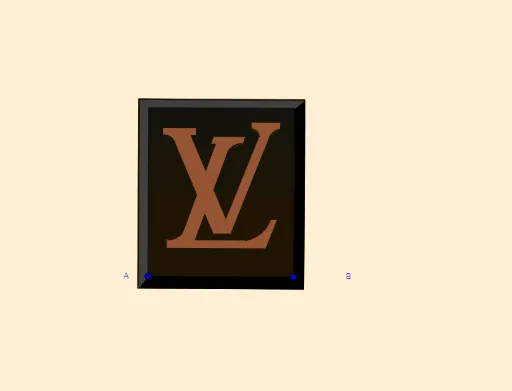
This example demonstrates how to draw the iconic Louis Vuitton logo using 2D vectors and geometric constructions. The core mathematical concepts involved include vectors, line segments, linear functions, ratios, equilateral triangles, cones, and trigonometric functions. The construction highlights GeoGebra commands such as Line, OrthogonalLine, LineBisector, Vector, OrthogonalVector, Intersect, Midpoint, Mirror, Polygon, and CircleArc. It is suitable for high school and above, focusing on vector operations, geometric transformations, and the application of analytical geometry.
GeoGebra Commands & Parameters
Line(A, B) → sOrthogonalLine(A, s) → bLineBisector(A, B) → mVector(A, B) → uOrthogonalVector(u) → vLineBisector(A, C) → dIntersect(m, d) → IOrthogonalLine(V, m) → f_1OrthogonalLine(A_1, m) → h_1OrthogonalLine(B_1, m) → i_1Midpoint(C, A) → JOrthogonalLine(L, d) → jIntersect(j, f_1) → F_1OrthogonalLine(C_1, d) → l_1Intersect(l_1, f_1) → J_1OrthogonalLine(D_1, d) → n_1Intersect(n_1, f_1) → L_1Intersect(n_1, h_1) → K_1OrthogonalLine(G_1, d) → j_1OrthogonalLine(K, d) → iMirror(N_1, m) → Q_1OrthogonalLine(V_1, i_1) → s_1Intersect(s_1, i_1) → W_1Mirror(i, m) → i'Intersect(i, s) → GOrthogonalLine(T, b) → tOrthogonalLine(H, b) → rIntersect(j_1, r) → I_1Line(F_1, I_1) → k_1Line(J_1, k_1) → m_1Intersect(m_1, t) → P_1Line(P_1, U_1) → p_1Line(T_1, p_1) → r_1Intersect(r, r_1) → M_2Line(C, B) → hIntersect(i, h) → H_1Intersect(m, d) → EOrthogonalLine(C, v, xOyPlane) → fIntersect(f, m) → UOrthogonalLine(B, u, xOyPlane) → gIntersect(g, f) → DPolygon(A, B, D, C) → q11, a_3, b_2, d_2, c_3OrthogonalLine(M, d) → kOrthogonalLine(R, b) → lOrthogonalLine(S, b) → pOrthogonalLine(O, m) → cOrthogonalLine(W, m) → eIntersect(k, p) → FIntersect(k, l) → ZOrthogonalLine(N, b) → nIntersect(h, n) → QMirror(Q, m) → Q'Mirror(Q'', m) → Q'_1Polygon(Q'', Q'_1, Q, Q') → q2, q'', q'_1, q_2, q'Polygon(Q'_1, D, B, A, Q', Q) → poly2, q, d_1, b_1, a_1, g_1, q_1OrthogonalLine(P, m) → aLine(R_1, r_1) → t_1Intersect(t_1, l) → Z_1Intersect(m_1, e) → B_2Line(F, B_2) → c_1Intersect(p, n_1) → D_2Line(D_2, c_1) → e_1Intersect(c, c_1) → E_2Intersect(c, e_1) → F_2Line(G_2, c_1) → f_2Intersect(c_1, f_2) → H_2Intersect(f_2, a) → I_2Line(K_2, e_1) → g_2Polygon(N_1, M_1, U_1, P_1, J_1, L_1, K_1, F_1, I_1, M_2, T_1, Q_1, S_1, W_1, V_1) → poly1, h_2, s_2, t_2, a_2, c_2, e_2, f_3, i_2, j_2, k_2, l_2, m_2, n_2, p_2, r_2Intersect(g_2, a) → L_2Polygon(I_2, L_2, S, F, E_2, G_2, K_2, F_2, D_2, C_2, A_2, R_1, Z_1, R) → poly3, g_3, r_3, s_3, f_4, p_3, q_3, h_3, i_3, j_3, k_3, l_3, m_3, n_3, z_1LineBisector(A_2, C_2) → t_3Intersect(r_1, t_3) → O_1CircleArc(O_1, C_2, A_2) → d_3Polygon(Q', A, C, D, Q'_1, Q'') → poly4, b_3, a_4, c_4, d_4, e_3, g_4Vector(F, E_2) → wVector(I_1, F_1) → u_1LineBisector(S, N_2) → h_4Intersect(t, h_4) → S_2CircleArc(S_2, S, N_2) → e_4Polygon(S, N_2, F) → t1, f_5, s_4, i_4Intersect(b, c) → T_2Mirror(T_2, m) → U_2Polygon(T_2, U_2, D, C) → q1, j_4, u_2, d_5, c_5LineBisector(O_2, M_1) → k_4Intersect(i, k_4) → V_2CircleArc(V_2, O_2, M_1) → p_4Polygon(O_2, F_1, M_1) → t2, l_4, o_2, m_4LineBisector(P_2, K_2) → n_4Intersect(g_2, n_4) → W_2LineBisector(Q_2, Q_1) → r_4Intersect(r_4, i') → Z_2CircleArc(Z_2, Q_1, Q_2) → t_4LineBisector(V_1, R_2) → b_4Intersect(b_4, a) → A_3CircleArc(A_3, R_2, V_1) → e_5Polygon(P_2, K_2, F_2) → t3, g_5, h_5, i_5Polygon(V_1, R_2, U_1) → t4, j_5, v_1, k_5Polygon(Q_1, Q_2, T_1) → t5, l_5, m_5, n_5Intersect(n_4, p_1) → J_2Midpoint(W_2, J_2) → B_3CircleArc(B_3, K_2, P_2) → q_4Intersect(c, b) → C_3Mirror(J, m) → J'Mirror(C_3, m) → D_3Polygon(J, C_3, D_3, J') → q3, j_6, p_5, q_5, j'
AI Drawing Prompt Reference
Draw the Louis Vuitton logo using 2D vectors and geometric constructions. Start by drawing line segment AB, then construct the perpendicular bisector m of AB, draw vector u and its perpendicular vector v, and use these to construct a series of intersections and line segments to form the logo's outline.
The prompt above was compiled from the original drawing commands and is for reference only.