
Metric Relationships Proven Briefly
Loading the math board and drawing, please wait…
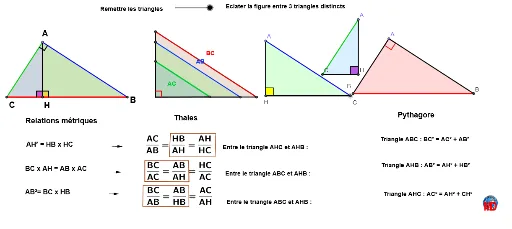
This example dynamically demonstrates metric relationships in geometric figures like rectangles and triangles, revealing intrinsic mathematical principles. Core concepts include coordinate geometry, trigonometric functions, vector operations, and geometric transformations. Construction highlights the use of GeoGebra commands/objects such as Line, Point, Circle, Segment, Intersect, OrthogonalLine, Polygon, Vector, Translate, Midpoint, and Angle. Suitable for high school and above, it bridges geometric proofs with dynamic geometry.
GeoGebra Commands & Parameters
Line(O, xAxis) → bPoint(b) → ECircle(O, a) → cPoint(c) → ASegment(A, E) → d2Circle(A, If[t < d2, t, d2]) → e2Intersect(c, b) → C, BSegment(A, C) → eOrthogonalLine(E, b) → iCircle(E, e) → kIntersect(k, i) → G, ISegment(C, I) → b2Circle(C, If[t < b2, t, b2]) → c2Segment(A, E) → t1Line(A, E) → h1Segment(A, E) → f1Circle(A, If[t < f1, t, f1]) → g1Intersect(g1, h1) → U, VLine(C, I) → nSegment(C, I) → d1Circle(C, If[t < t1, t, t1]) → pSegment(A, B) → fCircle(E, f) → hIntersect(h, b) → D, FSegment(B, F) → i1Circle(B, If[t < i1, t, i1]) → k1OrthogonalLine(A, b) → dIntersect(d, b) → HSegment(A, H) → gSegment(I, F) → jSegment(I, E) → lSegment(E, F) → mLine(A, b) → qIntersect(q, i) → LSegment(H, B) → rCircle(E, r) → sIntersect(s, b) → M, NSegment(L, N) → a1Circle(E, g) → c1Intersect(c1, b) → J, KSegment(C, H) → b1Circle(E, b1) → e1Intersect(e1, i) → P, QPolygon(I, E, F) → poly1, f_1, i_1, e_1Polygon(A, C, B) → poly2, b_1, a_1, c_1Polygon(A, H, B) → poly3, b_2, a_2, h_1Polygon(L, E, N) → poly4, n_1, l_1, e_2Polygon(A, C, H) → poly5, h_2, a_3, c_2Polygon(Q, E, K) → poly6, k_1, q_1, e_3Intersect(f1, h1) → TIntersect(k1, t1) → Z, H1Segment(A, L) → j1_1Circle(A, If[t < j1_1, t, j1_1]) → p1Intersect(p1, j1_1) → A1, B1Vector(A, A1) → uTranslate(A, u) → A'Translate(H, u) → H'Translate(B, u) → B'Polygon(A', H', B') → poly3', b', a', h'Segment(A, K) → m1_2Circle(A, If[t < m1_2, t, m1_2]) → q1Intersect(q1, m1_2) → C1, D1Segment(C, Q) → l1_2Circle(C, If[t < l1_2, t, l1_2]) → r1Intersect(r1, l1_2, 1) → E1Segment(H, E) → n1Circle(H, If[t < n1, t, n1]) → s1Intersect(s1, b) → F1, G1Polygon(C1, E1, G1) → poly8, g1_1, c1_1, e1_1Segment(B, F) → j1Intersect(k1, j1) → I1, J1Intersect(c2, b2) → S, RIntersect(e2, d2) → W, K1Segment(S, W) → l1Segment(W, I1) → m1Segment(I1, S) → a2Polygon(S, W, I1) → poly7, i1_1, s_1, wCircle(H, a / 10) → f2Intersect(f2, r) → L1,Intersect(f2, b1) → M1,Intersect(f2, g) → N1,Circle(A, a / 10) → g2Intersect(g2, f) → O1,Intersect(g2, e) → P1,Line(O1, e) → h2Line(P1, f) → i2Intersect(i2, h2) → Q1Segment(O1, Q1) → j2Segment(Q1, P1) → k2Line(M1, g) → l2Line(L1, g) → m2Line(N1, r) → n2Intersect(l2, n2) → R1Intersect(m2, n2) → S1Polygon(R1, M1, H, N1) → poly9, r1_1, m1_1, h_3, n1_1Polygon(N1, S1, L1, H) → poly10, n1_2, s1_1, l1_1, h_4Circle(E, a / 10) → p2Intersect(p2, c1_1) → U1,Line(U1, r) → r2Intersect(p2, e1_1) → V1,Line(V1, g) → q2Line(U1, r) → s2Intersect(s2, q2) → W1Polygon(U1, W1, V1, E) → poly11, u1, w1, v1, e_4Midpoint(w) → Z1Midpoint(h') → A2Midpoint(g1_1) → B2Polygon(C2, D2, E2, F2) → poly12, c2_1, d2_1, e2_1, f2_1Polygon(G2, H2, I2, J2) → poly13, g2_1, h2_1, i2_1, j2_1Vector(K2, L2) → vVector(M2, N2) → zVector(O2, P2) → z1Polygon(Q2, R2, S2, U2) → poly14, q2_1, r2_1, s2_1, u2Vector(E, A_1) → u_1Vector(E, B_1) → v_1Vector(H, C_1) → w_1Translate(W, Vector[(t / 10 * w_1)]) → W'Translate(A, Vector[(t / 10 * u_1)]) → A'_1Translate(H, Vector[(t / 10 * u_1)]) → H'_1Translate(B, Vector[(t / 10 * u_1)]) → B'_1Polygon(A'_1, H'_1, B'_1) → poly3'_1, b'_1, a'_1, h'_1Translate(A, Vector[(t / 10 * v_1)]) → A'_2Translate(C, Vector[(t / 10 * v_1)]) → C'Translate(H, Vector[(t / 10 * v_1)]) → H'_2Polygon(A'_2, C', H'_2) → poly5', h'_2, a'_2, c'Translate(A, Vector[(t / 10 * w_1)]) → A'_3Translate(C, Vector[(t / 10 * w_1)]) → C'_1Translate(B, Vector[(t / 10 * w_1)]) → B'_2Polygon(A'_3, C'_1, B'_2) → poly2', b'_2, a'_3, c'_1Segment(C'_1, B'_2) → d_1Angle(C'_1, A'_3, B'_2) → αAngle(A'_2, H'_2, C') → βAngle(B'_1, H'_1, A'_1) → γSegment(C'_1, B'_2) → g_1Segment(A'_2, C') → j_1Segment(A'_1, B'_1) → m_1Segment(A'_1, H'_1) → p_1Segment(H'_1, B'_1) → r_1Segment(A'_3, B'_2) → t_1Segment(A'_3, C'_1) → d_2Segment(A'_2, H'_2) → f_2Segment(C', H'_2) → g_2Angle(A'_2, H'_2, C') → δAngle(B'_1, H'_1, A'_1) → ε
AI Drawing Prompt Reference
Draw a dynamic geometric figure demonstrating metric relationships in rectangles and triangles. Include coordinate axes, circles, line segments, and points, constructed through intersections and perpendicular lines. Use vector operations and geometric transformations to reveal intrinsic mathematical principles, ultimately forming multiple polygons to show the connection between dynamic geometry and geometric proofs.
The prompt above was compiled from the original drawing commands and is for reference only.