
Dynamic Geometry Demo: Power Functions & Similarity Transformation
Loading the math board and drawing, please wait…
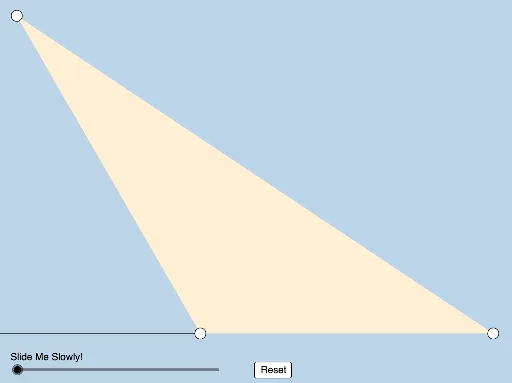
①This example dynamically illustrates a problem posted by Antonio Gutierrez on Twitter, involving power functions, linear equations, rhombus, polynomial functions, and similarity transformation; ②Core math concepts include function graphs, geometric transformations, similarity, and analytical geometry; ③Construction highlights utilize GeoGebra commands/objects such as Line, Rotate, Ray, Point, Segment, Polygon, Angle, Intersect, Min, Circle, Dilate, and CircleSector; ④Suitable for high school and above students to understand the relationship between function transformations and geometric figures.
GeoGebra Commands & Parameters
Line(B, A) → fRotate(A, (2 * π / 3), B) → B'Ray(B, B') → gPoint(g) → CRay(A, B) → hSegment(B, C) → iSegment(A, C) → jPolygon(B, A, C) → t1, c, a_1, bRotate(A, π / 3, B) → B'_1Ray(B, B'_1) → kAngle(C, A, B) → αRotate(C, α / 2, A) → C'Angle(C, A, C') → βRay(A, C') → lIntersect(k, l) → IMin({Distance[B, A], i, j}) → dCircle(B, (0.2 * d)) → eCircle(A, (0.2 * d)) → pIntersect(e, h, 1) → E_1Intersect(p, j, 1) → F_1Ray(C, I) → mIntersect(h, m) → FIntersect(j, k) → EIntersect(g, l) → DIntersect(e, h, 2) → GRay(B, G) → nRotate(E_1, If[0 < a ≤ 1, (a * π / 3), π / 3], B) → HDilate(B, If[0 < a ≤ 1, 1 - a, 0], I) → B'_2Segment(B, B'_2) → qCircleSector(B, E_1, H) → rRotate(r, If[2 < a ≤ 3, ((a - 2) * π / 3), π / 3], B) → r'Rotate(r', If[4 < a ≤ 5, ((a - 4) * π / 3), π / 3], B) → r''Dilate(A, If[5 < a ≤ 6, 6 - a, 0], I) → A'Segment(A, A') → sDilate(C, If[5 < a ≤ 6, 6 - a, 0], I) → C'_1Segment(C, C'_1) → tRotate(F_1, If[5 < a ≤ 6, ((a - 5) * β), β], A) → JCircleSector(A, F_1, J) → c_1Rotate(c_1, If[7 < a ≤ 8, ((a - 7) * β), β], A) → d_1Dilate(I, If[8 < a ≤ 9, 9 - a, 0], E) → I'Dilate(I, If[8 < a ≤ 9, 9 - a, 0], F) → I'_1Dilate(I, If[8 < a ≤ 9, 9 - a, 0], D) → I'_2Segment(I, I') → f_1Segment(I, I'_1) → g_1Segment(I, I'_2) → h_1Dilate(A, If[9 < a ≤ 10, 10 - a, 0], F) → A'_1Dilate(C, If[9 < a ≤ 10, 10 - a, 0], D) → C'_2Segment(A, A'_1) → i_1Segment(C, C'_2) → j_1Angle(B, C, A) → γRotate(C, If[11 < a ≤ 12, ((a - 11) * γ), γ], C) → C'_3Rotate(C'_2, If[11 < a ≤ 12, ((a - 11) * γ), γ], C) → KSegment(C'_3, K) → k_1Rotate(A, If[12 < a ≤ 13, ((-(a - 12)) * α), (-α)], A) → A'_2Rotate(A'_1, If[12 < a ≤ 13, ((-(a - 12)) * α), (-α)], A) → LSegment(A'_2, L) → l_1Angle(I, E, L) → δRotate(I, If[13 < a ≤ 14, ((a - 13) * δ), δ], E) → I'_3Rotate(I', If[13 < a ≤ 14, ((a - 13) * δ), δ], E) → I''Segment(I'_3, I'') → m_1Rotate(I'_3, If[14 < a ≤ 15, ((a - 14) * π), π], E) → MRotate(I'', If[14 < a ≤ 15, ((a - 14) * π), π], E) → I'''Segment(M, I''') → n_1