
Dynamic Geometric Illustration by Tim Brzezinski
Loading the math board and drawing, please wait…
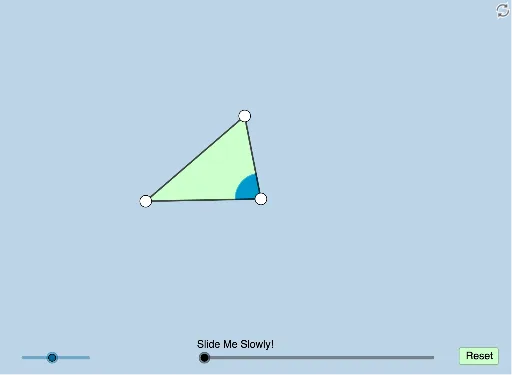
This example demonstrates a dynamic and modifiable illustration of a problem posted by Antonio Gutierrez on Twitter. It involves core mathematical concepts such as square, polynomial functions, fractal geometry, addition, unit circle, and division. Construction highlights include using commands and objects like Segment, Rotate, Angle, Ray, Point, Polygon, Midpoint, Line, Dilate, Vector, Translate, Intersect, Min, Circle, and CircleSector. Suitable for high school students and enthusiasts to explore and visualize complex geometric and algebraic relationships.
GeoGebra Commands & Parameters
Segment(A, B) → fRotate(B, (a * π / 180), A) → B'Angle(B, A, B') → αRay(A, B') → gPoint(g) → CSegment(C, B) → hSegment(A, C) → iPolygon(B, A, 4) → poly1, j, k, l, m, D, EPolygon(E, D, 4) → poly2, n, p, q, r, F, GPolygon(A, C, 4) → poly3, s, t, b, c, H, IPolygon(C, B, 4) → poly4, d, e, f_1, g_1, J, KPolygon(A, B, C) → t1, c_1, a_1, b_1Midpoint(F, E) → LLine(L, C) → h_1Line(D, K) → i_1Line(E, H) → j_1Angle(B, C, K) → βAngle(C, K, J) → γAngle(K, J, B) → δAngle(A, I, H) → εAngle(I, H, C) → ζAngle(C, A, I) → ηAngle(A, B, E) → θAngle(B, E, D) → ιAngle(E, D, A) → κRotate(C, If[0 < o ≤ 1, (o * π / 2), π / 2], C) → C'Rotate(B, If[0 < o ≤ 1, (o * π / 2), π / 2], C) → B'_1Segment(C', B'_1) → h'Rotate(A, If[0 < o ≤ 1, (o * π / 2), π / 2], A) → A'Rotate(C, If[0 < o ≤ 1, (o * π / 2), π / 2], A) → C'_1Segment(A', C'_1) → i'Rotate(A, If[0 < o ≤ 1, (o * π / 2), π / 2], B) → A'_1Rotate(B, If[0 < o ≤ 1, (o * π / 2), π / 2], B) → B'_2Segment(A'_1, B'_2) → f'Rotate(C', If[1 < o ≤ 2, ((o - 1) * π / 2), π / 2], K) → C''Rotate(B'_1, If[1 < o ≤ 2, ((o - 1) * π / 2), π / 2], K) → MSegment(C'', M) → h''Rotate(A', If[1 < o ≤ 2, ((o - 1) * π / 2), π / 2], I) → A''Rotate(C'_1, If[1 < o ≤ 2, ((o - 1) * π / 2), π / 2], I) → NSegment(A'', N) → i''Rotate(A'_1, If[1 < o ≤ 2, ((o - 1) * π / 2), π / 2], E) → ORotate(B'_2, If[1 < o ≤ 2, ((o - 1) * π / 2), π / 2], E) → PSegment(O, P) → f''Rotate(C'', If[2 < o ≤ 3, ((o - 2) * π / 2), π / 2], J) → C'''Rotate(M, If[2 < o ≤ 3, ((o - 2) * π / 2), π / 2], J) → M'Segment(C''', M') → h'''Rotate(O, If[2 < o ≤ 3, ((o - 2) * π / 2), π / 2], D) → O'Rotate(P, If[2 < o ≤ 3, ((o - 2) * π / 2), π / 2], D) → P'Segment(O', P') → f'''Rotate(A'', If[2 < o ≤ 3, ((o - 2) * π / 2), π / 2], H) → A'''Rotate(N, If[2 < o ≤ 3, ((o - 2) * π / 2), π / 2], H) → N'Segment(A''', N') → i'''Rotate(O, If[4 < o ≤ 5, ((o - 4) * π / 2), π / 2], E) → O'_1Rotate(P, If[4 < o ≤ 5, ((o - 4) * π / 2), π / 2], E) → P'_1Segment(O'_1, P'_1) → f'''_1Dilate(E, If[5 < o ≤ 6, 6 - o, 0], D) → E'Vector(E, E') → uTranslate(O'_1, u) → QTranslate(P'_1, u) → RSegment(Q, R) → k_1Dilate(D, If[6 < o ≤ 7, 7 - o, 0], F) → D'Vector(D, D') → vTranslate(O, v) → O'_2Translate(P, v) → P'_2Segment(O'_2, P'_2) → f'''_2Dilate(F, If[7 < o ≤ 8, 8 - o, 0], L) → F'Segment(F, F') → l_1Dilate(L, If[8 < o ≤ 9, 9 - o, 0], E) → L'Segment(L, L') → m_1Rotate(F, If[9 < o ≤ 10, ((o - 9) * π), π], L) → F'_1Rotate(F', If[9 < o ≤ 10, ((o - 9) * π), π], L) → F''Segment(F'_1, F'') → n_1Intersect(h_1, j_1) → SDilate(L, If[11 < o ≤ 12, 12 - o, 0], C) → L'_1Segment(L, L'_1) → p_1Dilate(H, If[12 < o ≤ 13, 13 - o, 0], S) → H'Segment(H, H') → q_1Dilate(S, If[13 < o ≤ 14, 14 - o, 0], E) → S'Segment(S, S') → r_1Dilate(K, If[14 < o ≤ 15, 15 - o, 0], S) → K'Segment(K, K') → s_1Intersect(h_1, j_1) → TDilate(S, If[15 < o ≤ 16, 16 - o, 0], D) → S'_1Segment(S, S'_1) → t_1Min(f, i) → wCircle(A, (0.3 * w)) → d_1Intersect(d_1, f) → U,Intersect(d_1, i) → V,CircleSector(A, U, V) → e_1
AI Drawing Prompt Reference
Draw a dynamic geometric illustration featuring a square and four surrounding regular quadrilaterals that rotate around a central point. A line segment extends from the center to one corner of the square, forming a ray upon rotation. A point is placed at the end of the ray, connected to the opposite corner of the square by two line segments. Angle measurements are marked between the shapes, showing their relationships. The entire figure can be dynamically rotated to visualize geometric and algebraic concepts.
The prompt above was compiled from the original drawing commands and is for reference only.