
Dynamic Demonstration of the Sum of Angles in a Quadrilateral
Loading the math board and drawing, please wait…
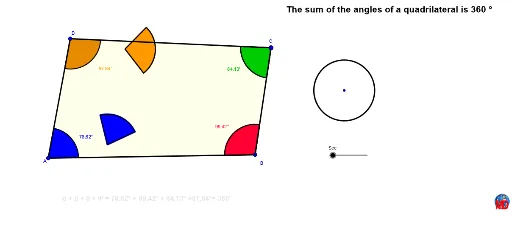
This GeoGebra example dynamically demonstrates that the sum of the interior angles of any quadrilateral is always 360°. It visually reinforces the fundamental polygon angle-sum theorem by allowing users to drag vertices and observe the angle measures update in real time. The core mathematical concepts include the polygon interior angle sum formula, angle measurement, and the proof technique of dividing a quadrilateral into two triangles via a diagonal. The construction utilizes a rich set of GeoGebra commands: Vector, Angle, Rotate, Midpoint, Mirror, Polygon, Ray, Line, Circle, Segment, and Point, involving numerous objects such as points (C, B, I, D_1, etc.), lines, and angle markers. This interactive tool is ideal for middle and high school geometry classes, helping students grasp why the sum remains constant regardless of the quadrilateral's shape, and can be used for exploratory learning or teacher demonstrations.
GeoGebra Commands & Parameters
Vector(C, D_1) → zVector(B, D_1) → wVector(D, D_1) → iAngle(S, D_1, I) → ΨRotate(S, (Ψ * b_1), K) → MVector(A, D_1) → vAngle(B', D_1, I) → ζRotate(C', (ζ * b_1), A') → LAngle(L, D_1, C'') → δRotate(C'', ((-δ) * b_2), B'') → ERotate(A'', ((-δ) * b_2), B'') → FAngle(E, B'', F) → βAngle(F, D_1, A''') → εRotate(A''', ((-ε) * b_3), C''') → GRotate(B''', ((-ε) * b_3), C''') → HAngle(G, C''', H) → θRotate(B', (ζ * b_1), A') → JAngle(J, A', L) → αRotate(T, (Ψ * b_1), K) → RAngle(R, K, M) → γMidpoint(D_1, I) → OMirror(O, D_1) → PAngle(A, D_1, B) → ηPolygon(A, B, C, D) → poly1, a, b, c, d_1Angle(B, A, C) → α_1Angle(C, B, A) → β_1Angle(A, C, B) → γ_1Ray(D_1, I) → dPolygon(C, B, A, D) → poly2, e_1, f_1, g_1, hLine(D_1, xAxis) → eCircle(D_1, I) → fSegment(P, O) → gPoint(g) → NPoint(g) → QSegment(A, B') → rCircle(D_1, U) → pAngle(R, K, M) → ιAngle(J, A', L) → κAngle(E, B'', F) → λAngle(G, C''', H) → μAngle(A, D, C) → νAngle(D, C, B) → ξAngle(C, B, A) → οAngle(B, A, D) → ρAngle(A, D, C) → σAngle(D, C, B) → τAngle(C, B, A) → υAngle(B, A, D) → ϕ