
Dynamic Demonstration of Perpendiculars in a Cyclic Quadrilateral
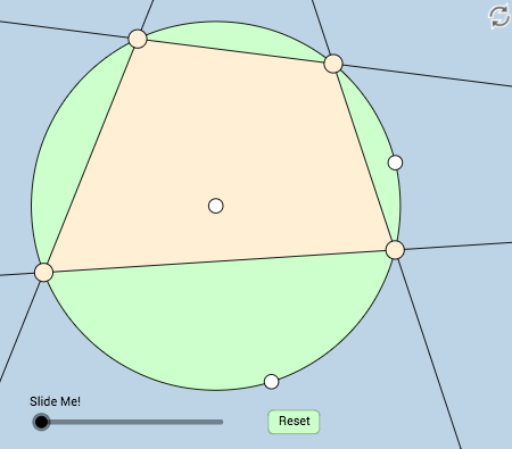
Loading the math board and drawing, please wait…
This example dynamically illustrates a surprising phenomenon that occurs when perpendiculars are drawn from the vertices of a cyclic quadrilateral inscribed in a circle. It involves core mathematical concepts such as circles, cyclic quadrilaterals, perpendiculars, angles, vectors, and geometric transformations. The construction utilizes GeoGebra commands and objects like Circle, Point, Rotate, CircleArc, Segment, Intersect, Ray, Polygon, Line, OrthogonalLine, Angle, Dilate, Vector, and Translate. It is suitable for high school mathematics instruction or exploration by geometry enthusiasts.
GeoGebra Commands & Parameters
Circle(A_1, B_1) → cPoint(c) → C_1Rotate(C_1, 2°, A_1) → C'CircleArc(A_1, C', C_1) → dPoint(d) → DCircleArc(A_1, D, C_1) → ePoint(e) → CCircleArc(A_1, C, C_1) → fPoint(f) → BCircleArc(A_1, B, C_1) → gPoint(g) → ASegment(D, C) → bSegment(C, B) → hSegment(D, A) → aSegment(A, B) → iCircle(B, (0.2 * Distance[A_1, B_1])) → kCircle(C, (0.2 * Distance[A_1, B_1])) → pCircle(A, (0.2 * Distance[A_1, B_1])) → qCircle(D, (0.2 * Distance[A_1, B_1])) → rIntersect(k, i, 1) → H_1Intersect(k, h, 1) → IIntersect(p, h, 1) → JIntersect(p, b, 1) → KIntersect(r, a, 1) → LIntersect(r, b, 1) → M_1Intersect(q, a, 1) → N_1Intersect(q, i, 1) → OCircle(A_1, B_1) → e_1Ray(D, A) → lPoint(l) → PRay(A, P) → mRay(A, D) → nPoint(n) → QRay(D, Q) → a_1Polygon(A, D, C, B) → poly1, g_2, d_2, e_2, f_2Line(A, D) → sLine(C, B) → tLine(C, D) → f_1Line(B, A) → h_1OrthogonalLine(C, s) → g_1OrthogonalLine(B, m) → i_1OrthogonalLine(D, h_1) → j_1Intersect(g_1, s) → GIntersect(i_1, s) → FOrthogonalLine(A, f_1) → k_1Intersect(f_1, k_1) → EIntersect(h_1, j_1) → HIntersect(i_1, j_1) → NIntersect(k_1, g_1) → MLine(N, M) → l_1Angle(B, F, A) → γAngle(D, G, C) → δAngle(C, E, A) → εAngle(D, H, B) → ζDilate(B, If[0 < o ≤ 1, 1 - o, 0], N) → B'Segment(B, B') → m_1Dilate(C, If[0 < o ≤ 1, 1 - o, 0], M) → C'_1Segment(C, C'_1) → n_1Dilate(D, If[2 < o ≤ 3, 3 - o, 0], N) → D'Dilate(N, If[3 < o ≤ 4, 4 - o, 0], H) → N'Segment(N, N') → p_1Dilate(N, If[1 < o ≤ 2, 2 - o, 0], F) → N'_1Segment(N, N'_1) → q_1Dilate(M, If[1 < o ≤ 2, 2 - o, 0], G) → M'Segment(M, M') → r_1Dilate(A, If[4 < o ≤ 5, 5 - o, 0], M) → A'Segment(A, A') → s_1Dilate(M, If[5 < o ≤ 6, 6 - o, 0], E) → M'_1Segment(M, M'_1) → t_1Dilate(N, If[6 < o ≤ 7, 7 - o, 0], M) → N'_2Segment(N, N'_2) → b_1Segment(N, B) → c_1Line(N, M) → h_2Dilate(N, If[7 < o ≤ 8, 8 - o, 0], B) → N'_3Segment(N, N'_3) → d_1Dilate(N, If[8 < o ≤ 9, 9 - o, 0], B) → N'_4Vector(N, N'_4) → uTranslate(N, u) → N'_5Translate(N'_2, u) → RSegment(N'_5, R) → i_2Dilate(N, If[9 < o ≤ 10, 10 - o, 0], M) → N'_6Vector(N, N'_6) → vTranslate(N, v) → N'_7Translate(N'_3, v) → SSegment(N'_7, S) → j_2Polygon(N, M, C, B) → poly2, n_2, m_2, c_2, b_2Dilate(D, If[2 < o ≤ 3, 3 - o, 0], N) → D'_1Segment(D, D'_1) → j