
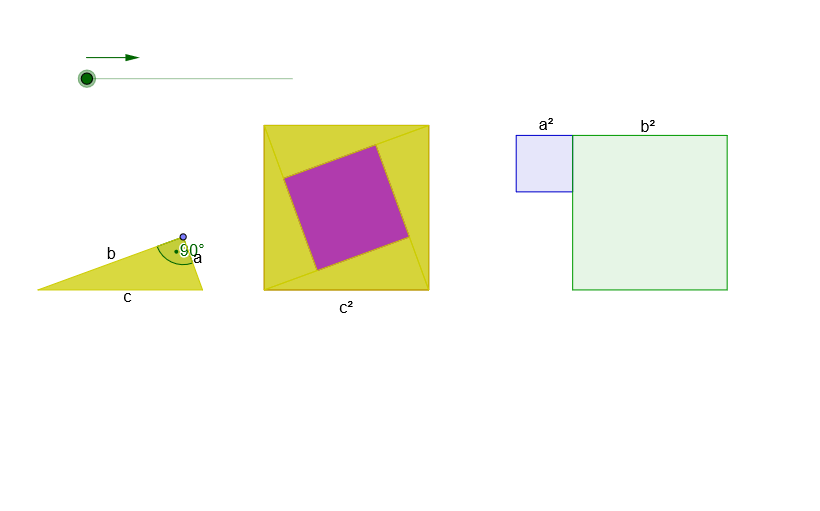
Dynamic Demonstration of Bhaskara's Proof of the Pythagorean Theorem
Loading the math board and drawing, please wait…
In collections
geometriadinamica.es
① This GeoGebra example dynamically demonstrates Bhaskara's classic proof of the Pythagorean theorem, showing that the sum of the areas of squares on the two legs equals the area of the square on the hypotenuse through geometric transformations and area comparison. ② Core mathematical concepts include the Pythagorean theorem, area conservation, triangle congruence, geometric transformations (translation and rotation), and polygon area calculations. ③ Construction highlights: using GeoGebra commands such as Midpoint, CircleArc, Point, Polygon, Angle, Vector, Translate, Line, OrthogonalLine, Intersect, and Rotate, the construction involves multiple triangles, quadrilaterals, and auxiliary lines, with dynamic elements (e.g., draggable points or sliders) to illustrate the proof step by step. ④ Suitable for middle school and above students to understand a geometric proof of the Pythagorean theorem, and also valuable for integrating history of mathematics into lessons, showing the elegance of area-based proofs.
GeoGebra Commands & Parameters
Midpoint(A, B) → A_1CircleArc(A_1, B, Z) → sPoint(s) → CPolygon(A, C, B) → P, b_1, a_1, c_1Angle(A, C, B) → αVector(A, D) → hTranslate(A, h) → A'Translate(C, h) → C'Translate(B, h) → B'Polygon(A', C', B') → P', b', a', c'Polygon(A', M, L, B') → Q, a'_1, m, l, b'_1Polygon(I, J, K, G) → R, i, j, k, g_1Polygon(G, H, F, E) → S, g_2, h_1, f_1, e_1Line(C', B') → nLine(M, n) → pOrthogonalLine(L, p) → qIntersect(p, b') → NIntersect(q, p) → OIntersect(q, n) → TPolygon(M, N, A') → U, a'_2, m_1, n_1Polygon(M, L, O) → V, o, m_2, l_1Polygon(T, B', L) → W, l_2, t, b'_2Polygon(T, O, N, C') → Y, t_1, o_1, n_2, c'_1Translate(T, g) → T'Translate(O, g) → O'Translate(N, g) → N'Translate(C', g) → C''Polygon(T', O', N', C'') → Y', t', o', n', c''Angle(C, A, B) → βRotate(T', ((-b) * β), N') → T''Rotate(O', ((-b) * β), N') → O''Rotate(N', ((-b) * β), N') → N''Rotate(C'', ((-b) * β), N') → C'''Polygon(T'', O'', N'', C''') → Y'', t'', o'', n'', c'''Translate(T, r) → T'_1Translate(B', r) → B''Translate(L, r) → L'Polygon(T'_1, B'', L') → W', l', t'_1, b''Rotate(T'_1, ((-c) * β), L') → T'_1'Rotate(B'', ((-c) * β), L') → B'''Rotate(L', ((-c) * β), L') → L''Polygon(T'_1', B''', L'') → W'', l'', t'_1', b'''Translate(M, u_1) → M'Translate(N, u_1) → N'_1Translate(A', u_1) → A''Polygon(M', N'_1, A'') → U', a'', m', n'_1Rotate(M', ((-d) * β), A'') → M''Rotate(N'_1, ((-d) * β), A'') → N'_1'Rotate(A'', ((-d) * β), A'') → A'''Polygon(M'', N'_1', A''') → U'', a''', m'', n'_1'Translate(M, v_1) → M'_1Translate(L, v_1) → L'_1Translate(O, v_1) → O'_1Polygon(M'_1, L'_1, O'_1) → V', o'_1, m'_1, l'_1Rotate(M'_1, ((-e) * β), M'_1) → M'_1'Rotate(L'_1, ((-e) * β), M'_1) → L'_1'Rotate(O'_1, ((-e) * β), M'_1) → O'_1'Polygon(M'_1', L'_1', O'_1') → V'', o'_1', m'_1', l'_1'Translate(A', w_1) → A''_1Translate(C', w_1) → C''_1Translate(B', w_1) → B''_1Polygon(A''_1, C''_1, B''_1) → P'', b''_1, a''_1, c''_1Rotate(A''_1, ((-f) * β), A''_1) → A''_1'Rotate(C''_1, ((-f) * β), A''_1) → C''_1'Rotate(B''_1, ((-f) * β), A''_1) → B''_1'Polygon(A''_1', C''_1', B''_1') → P''', b''_1', a''_1', c''_1'Vector(B_1, C_1) → z_1
AI Drawing Prompt Reference
Draw a right triangle with squares on its two legs and a square on the hypotenuse. Demonstrate dynamically that the sum of the areas of the squares on the legs equals the area of the square on the hypotenuse through geometric transformations and area comparisons. Include multiple triangles, quadrilaterals, and auxiliary lines, with draggable points or sliders to illustrate the proof step by step.
The prompt above was compiled from the original drawing commands and is for reference only.