
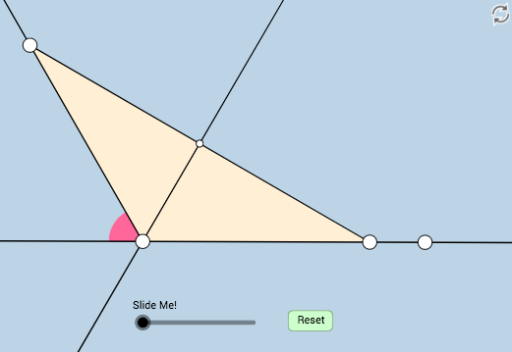
Dynamic Demonstration of Angle Bisectors in a Triangle with a 120-Degree Angle
Loading the math board and drawing, please wait…
This example dynamically illustrates the intersection points and geometric properties of the three angle bisectors in any triangle that contains a 120-degree angle. It involves core mathematical concepts such as triangles, angle bisectors, geometric transformations, and symmetry. The construction utilizes GeoGebra commands and objects like Rotate, Ray, Point, Line, Segment, Angle, Intersect, Min, Mirror, Circle, CircleSector, Polygon, OrthogonalLine, and Dilate. It is suitable for high school students and geometry enthusiasts to explore and understand the geometric properties of special triangles.
GeoGebra Commands & Parameters
Rotate(B, π / 3, A) → B'Ray(A, B') → hPoint(h) → CLine(A, C) → eRotate(B', π / 3, A) → B''Ray(A, B'') → gPoint(g) → URay(A, B) → jPoint(j) → DSegment(A, D) → sAngle(A, U, D) → ζRotate(A, ζ / 2, U) → A'_1Ray(U, A'_1) → g_1Intersect(g_1, e) → KSegment(A, K) → i_1Intersect(g_1, s) → ISegment(A, I) → h_1Angle(U, D, A) → εRotate(U, ε / 2, D) → U'Ray(D, U') → f_1Intersect(f_1, g) → GSegment(A, G) → bMin({h_1, i_1, b}) → oLine(A, B) → fAngle(B, A, B') → αAngle(B', A, B'') → βMirror(B, A) → B'_1Segment(C, D) → iRay(A, B'_1) → kSegment(A, D) → lSegment(A, C) → mCircle(A, (0.55 * o)) → cIntersect(c, k, 1) → EIntersect(c, g) → F,CircleSector(A, F, E) → dRotate(d, If[0 < a ≤ 1, ((-a) * π / 3), ((-π)) / 3], A) → d'Polygon(A, U, D) → poly1, a_1, c_1, d_1Rotate(d', If[2 < a ≤ 3, ((-(a - 2)) * π / 3), ((-π)) / 3], A) → d''Line(A, C) → nOrthogonalLine(D, n) → pIntersect(n, p) → JLine(A, D) → qOrthogonalLine(C, q) → rIntersect(r, q) → HLine(A, C) → n_1Circle(C, 1) → e_1Intersect(e_1, n_1, 2) → NCircle(A, 1) → p_1Intersect(p_1, n_1) → O, PRay(C, N) → q_1Ray(A, O) → r_1Ray(A, D) → s_1Circle(D, 1) → t_1Intersect(t_1, s_1) → Q, RRay(D, R) → b_1Ray(D, U) → j_2Ray(A, C) → tAngle(U, D, U') → ηAngle(A, U, A'_1) → θIntersect(e, j_2) → LSegment(D, U) → j_1Segment(D, I) → k_1Segment(D, L) → f_2Segment(D, K) → g_2Segment(U, L) → h_2Segment(U, K) → i_2Segment(U, G) → k_2Line(A, D) → l_2Min({s, f_2, g_2, h_2, i_2, k_2}) → uCircle(D, (0.4 * u)) → c_2Circle(U, (0.4 * u)) → d_2Intersect(d_2, g) → S, TIntersect(d_2, g_1) → V,Intersect(c_2, j_1) → W,Intersect(c_2, f_1) → Z,CircleSector(D, W, Z) → e_2CircleSector(U, S, V) → p_2Dilate(D, If[3 < a ≤ 4, 4 - a, 0], G) → D'Segment(D, D') → m_2Dilate(U, If[4 < a ≤ 5, 5 - a, 0], I) → U'_1Segment(U, U'_1) → n_2Rotate(e_2, If[5 < a ≤ 6, ((a - 5) * η), η], D) → q_2Rotate(p_2, If[6 < a ≤ 7, ((a - 6) * θ), θ], U) → r_2Ray(G, L) → s_2Ray(I, L) → t_2Intersect(n_2, s_2) → A_1Line(U, I) → a_2Intersect(e, a_2) → B_1Intersect(t_2, m_2) → C_1Segment(L, A_1) → b_2Segment(L, B_1) → f_3Segment(L, C_1) → g_3Min({b_2, f_3, g_3}) → vCircle(L, (0.4 * v)) → c_3Intersect(c_3, s_2) → D_1, E_1Intersect(c_3, t_2) → F_1, G_1CircleSector(L, D_1, F_1) → d_3Dilate(G, If[7 < a ≤ 8, 8 - a, 0], L) → G'Dilate(I, If[7 < a ≤ 8, 8 - a, 0], L) → I'Segment(G, G') → l_1Segment(I, I') → m_1Rotate(d_3, If[9 < a ≤ 10, ((a - 9) * π / 2), π / 2], L) → e_3