
Dynamic Demo of Isosceles Triangles and Polynomial Functions
Loading the math board and drawing, please wait…
In collections
Congruence (CO) Cluster
Congruence (Vol 2)
CCSS High School: Geometry (Congruence) Volume 2
CCSS High School: Geometry (Congruence) Volume 2
CCSS High School: Geometry (Congruence) Volume 2
Geometry (Congruence) Volume 2
CCSS High School: Geometry (Congruence) Volume 2
CCSS High School: Geometry (Congruence) Volume 2
CCSS High School: Geometry (Congruence) Volume 2
CCSS High School: Geometry (Congruence) Volume 2
CCSS High School: Geometry (Congruence) Volume 2
CCSS High School: Geometry (Congruence) Volume 2
CCSS High School: Geometry (Congruence) Volume 2
Gail LeBlancCCSS High School: Geometry (Congruence) Volume 2
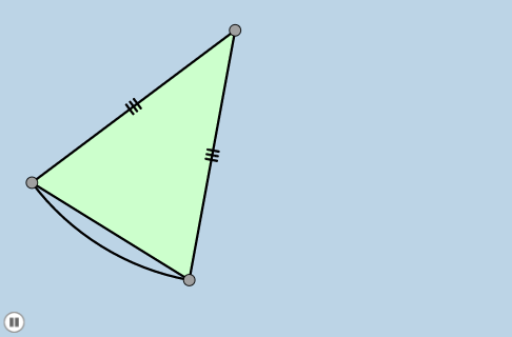
This example dynamically demonstrates the properties of isosceles triangles and their correlation with polynomial functions, trigonometric functions, and parametric curves. Key math concepts include isosceles triangles, sine/cosine functions, parametric curves, correlation, and orthocenter. GeoGebra commands used in construction are Circle, Intersect, Dilate, Rotate, and Midpoint. Suitable for high school and above students to understand the dynamic relationship between geometric transformations and function graphs.
GeoGebra Commands & Parameters
Circle(A, B) → cIntersect(c, q) → O, PCircleArc(A, O, P) → dPoint(d) → CCircleArc(A, C, P) → ePoint(e) → DDilate(A, If[0 < j ≤ 1, 1 - j, 0], C) → A'Segment(A, A') → aAngle(C, A, D) → αRotate(A, If[1 < j ≤ 2, ((j - 1) * α), α], A) → A'_1Rotate(A', If[1 < j ≤ 2, ((j - 1) * α), α], A) → A''Segment(A'_1, A'') → a'Segment(A, C) → bSegment(C, D) → fSegment(D, A) → gMidpoint(f) → ESegment(A, E) → hMidpoint(h) → FSegment(A, F) → iSegment(F, E) → kCircle(A, (0.35 * i)) → pCircle(E, (0.15 * Distance[D, E])) → rIntersect(r, f, 2) → GIntersect(r, h, 1) → HIntersect(r, f, 1) → IIntersect(p, b, 1) → JIntersect(p, h, 1) → KIntersect(p, g, 1) → LCircle(A, B) → c_1Dilate(C, If[2 < j ≤ 3, 3 - j, 0], D) → C'Segment(C, C') → lPolygon(C, D, A) → poly1, a_1, c_2, d_1Circle(C, (0.2 * Distance[D, E])) → e_1Intersect(e_1, b) → M,Intersect(e_1, f) → N,Dilate(A, If[3 < j ≤ 4, 4 - j, 0], F) → A'_2Dilate(F, If[5 < j ≤ 6, 6 - j, 0], E) → F'Dilate(E, If[6 < j ≤ 7, 7 - j, 0], D) → E'Rotate(E, If[7 < j ≤ 8, ((j - 7) * π), 3.141592653589793], E) → E'_1Rotate(E', If[7 < j ≤ 8, ((j - 7) * π), 3.141592653589793], E) → E''Dilate(C, If[9 < j ≤ 10, 10 - j, 0], D) → C'_1Vector(C, C'_1) → uAngle(E, C, A) → βCircleArc(A, C, A'') → s_1