
Double Reflections (Parallel Lines)
Loading the math board and drawing, please wait…
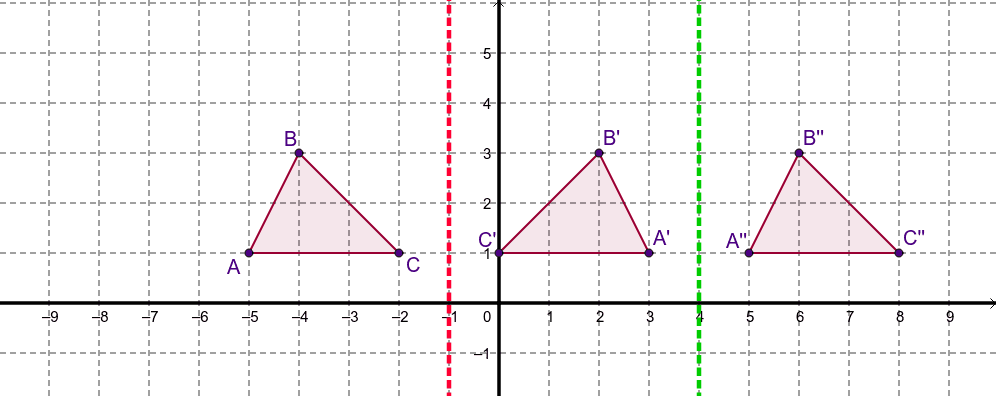
① This example demonstrates what happens when a polygon is reflected twice across two parallel lines, showing the composite effect of successive mirror transformations. ② Core mathematical concepts include axial symmetry (mirror reflection), composition of reflections, and how parallel-line reflections affect position and orientation. ③ Construction details: Using GeoGebra's Polygon command to create the initial polygon poly1, then applying the Mirror command about two parallel lines a and b to obtain the first reflected polygon poly1' and its corresponding edges a', b', followed by a second reflection of poly1' about one of the lines to produce poly1'', while retaining all intermediate objects (points A, B, C and their images A', B', C', A'', B'', C'') for clear visualization. ④ Suitable for middle/high school geometry or introductory transformation courses, helping students understand iteration and composition of reflections, and the special property that two reflections across parallel lines are equivalent to a translation.
GeoGebra Commands & Parameters
Polygon(A, B, C) → poly1, c, a_1, b_1Mirror(A, d) → A'Mirror(B, d) → B'Mirror(C, d) → C'Polygon(A', B', C') → poly1', c', a', b'Mirror(A', e) → A''Mirror(B', e) → B''Mirror(C', e) → C''Polygon(A'', B'', C'') → poly1'', c'', a'', b''
AI Drawing Prompt Reference
Draw a triangle ABC, then reflect it twice using two parallel lines d and e to generate a new triangle A''B''C''. First, draw triangle ABC with points A, B, and C. Then, reflect A, B, and C across line d to get A', B', and C', forming the first reflected triangle A'B'C'. Finally, reflect A', B', and C' across line e to obtain the final triangle A''B''C''.
The prompt above was compiled from the original drawing commands and is for reference only.