
Approximating Area under a Curve using Polygons
Loading the math board and drawing, please wait…
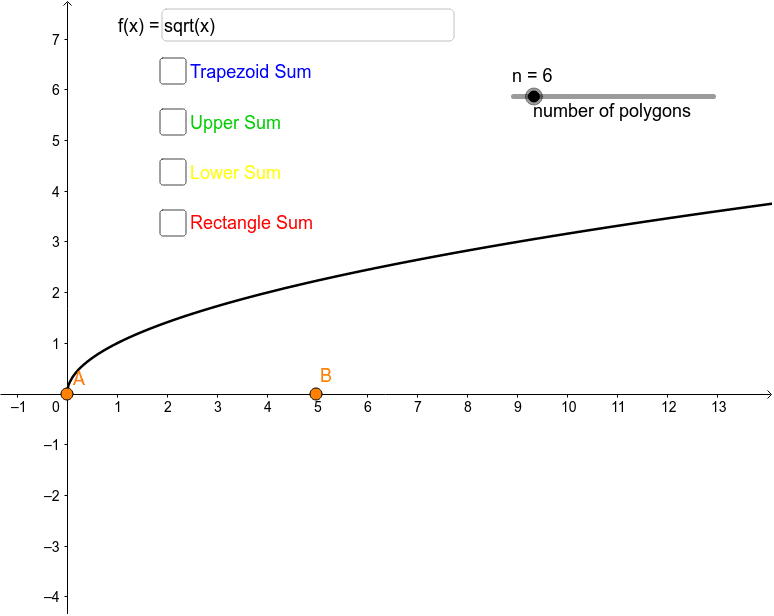
This example demonstrates how to approximate the area under a curve using polygons, visualizing upper sums, lower sums, and trapezoidal sums. Core mathematical concepts include area, polygons, upper and lower sums (or Riemann sums), differential equations, volume, integers, and division. It uses GeoGebra commands like Point, TrapezoidalSum, UpperSum, LowerSum, RectangleSum, Textfield, LaTeX, and objects such as f, n, A, B, a, b, c, m, d, inputBox1, text1, e, text2, g, text3, h, text4, text5, text6, i. Suitable for high school and above learning calculus and numerical integration concepts.
GeoGebra Commands & Parameters
Point(xAxis) → APoint(xAxis) → BTrapezoidalSum(f, x(A), x(B), n) → aUpperSum(f, x(A), x(B), n) → bLowerSum(f, x(A), x(B), n) → cRectangleSum(f, x(A), x(B), n, m) → dTextfield(f) → inputBox1LaTeX(a, true, true) → text1LaTeX(b, true, true) → text2LaTeX(c, true, true) → text3LaTeX(d, true, true) → text4