
Double Reflection over Intersecting Lines
Loading the math board and drawing, please wait…
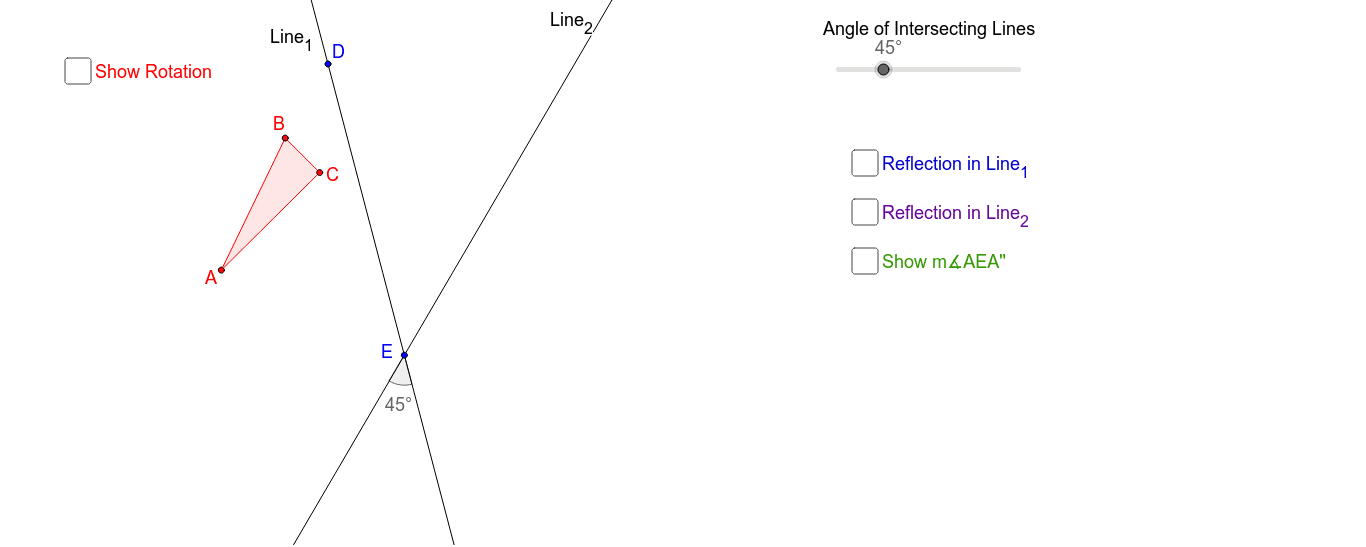
This GeoGebra example demonstrates the geometric transformation of double reflection across two intersecting lines. Key concepts include axial symmetry, rotational symmetry, and the composition of reflections. Construction utilizes commands such as Polygon, Line, Mirror, and Rotate to visualize how a figure transforms through successive reflections. It is designed for high school geometry students to explore the relationship between reflections and rotations, illustrating that two reflections over intersecting lines result in a rotation about the intersection point.
GeoGebra Commands & Parameters
Polygon(A, B, C) → poly1, c, a, bLine(D, E) → Line_1Rotate(Line_1, (-α), E) → Line_2Mirror(A, Line_1) → A'Mirror(B, Line_1) → B'Mirror(C, Line_1) → C'Polygon(A', B', C') → poly1', c', a', b'Mirror(A', Line_2) → A''Mirror(B', Line_2) → B''Mirror(C', Line_2) → C''Polygon(A'', B'', C'') → poly1'', c'', a'', b''Angle(Line_2, Line_1) → βAngle(A'', E, A) → γSegment(E, A'') → eSegment(E, A) → fRotate(A, (-Rotation), E) → A'_1Rotate(B, (-Rotation), E) → B'_1Rotate(C, (-Rotation), E) → C'_1Polygon(A'_1, B'_1, C'_1) → poly1'_1, c'_1, a'_1, b'_1Segment(A, E) → iSegment(E, A'_1) → jAngle(A'_1, E, A) → δ