
Double Box-lid (Mouhefanggai)
Loading the math board and drawing, please wait…
In collections
intersection: surface-surface, curve-curve
surface 3D /3D-Oberflächen 1
surface 3D /3D-Oberflächen 1
intersection: surface-surface, curve-curve
intersection: surface-surface, curve-curve
intersection: surface-surface, curve-curve
Volumes and Surface Areas of Pyramids, Cones and Spheres
Volumes in Ancient Chinese Mathematics 中國古算中的體積
Volumes of Pyramid and Sphere in Ancient Chinese Mathematics
Volume of Spheres in Ancient Chinese Mathematics
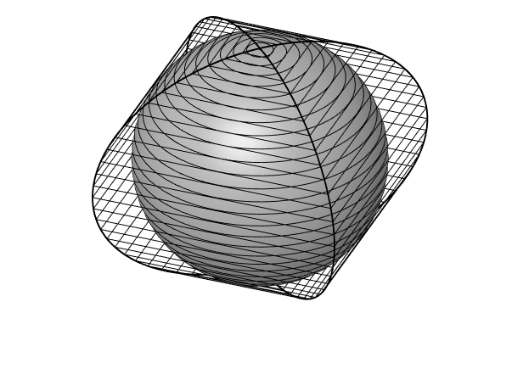
This example demonstrates the geometric construction of the Mouhefanggai, an ancient Chinese geometric solid used to calculate the volume of a sphere. Key mathematical concepts include spheres, volume, and functions. Using GeoGebra commands such as Surface, Sphere, CurveCartesian, and Sequence, the formation of the Mouhefanggai is dynamically illustrated. Suitable for high school mathematics education and research.
GeoGebra Commands & Parameters
Surface(sqrt(1 - t^(2)), (s * sqrt(1 - t^(2))), t + 1, s, -1, 1, t, -1, 1) → bSphere((0, 0, 1), r) → aSurface((s * sqrt(1 - t^(2))), sqrt(1 - t^(2)), t + 1, s, -1, 1, t, -1, 1) → cSurface((-sqrt(1 - t^(2))), (s * sqrt(1 - t^(2))), t + 1, s, -1, 1, t, -1, 1) → dSurface((s * sqrt(1 - t^(2))), (-sqrt(1 - t^(2))), t + 1, s, -1, 1, t, -1, 1) → eCurveCartesian(sqrt(1 - t^(2)), sqrt(1 - t^(2)), t + 1, t, -1, 1) → fCurveCartesian((-sqrt(1 - t^(2))), sqrt(1 - t^(2)), t + 1, t, -1, 1) → gCurveCartesian((-sqrt(1 - t^(2))), (-sqrt(1 - t^(2))), t + 1, t, -1, 1) → hCurveCartesian(sqrt(1 - t^(2)), (-sqrt(1 - t^(2))), t + 1, t, -1, 1) → iSequence(Circle[(0, 0, 1 - (r * cos(θ))), (r * sin(θ)), zAxis], θ, 0, π, π / n) → list3Sequence(Polygon[((-sin(θ)), (-sin(θ)), 1 - cos(θ)), (sin(θ), (-sin(θ)), 1 - cos(θ)), (sin(θ), sin(θ), 1 - cos(θ)), ((-sin(θ)), sin(θ), 1 - cos(θ))], θ, 0, π, π / n) → list4
AI Drawing Prompt Reference
Draw a 3D geometric solid called the 'Mouhefanggai' (double box-lid). Start with a unit sphere centered at a point on the z-axis. Then construct four curved surfaces, each defined by parametric equations, resembling parts of cylinders that intersect perpendicularly, enclosing a space like two interlocking box lids. Add four spatial curves along the intersections of these surfaces to form the edges of the solid. Finally, include a sequence of horizontal circular rings and square cross-sections, evenly spaced from top to bottom, to illustrate the relationship with the sphere and the changing cross-sectional areas used in volume calculation. Render the solid semi-transparent for clear internal viewing.
The prompt above was compiled from the original drawing commands and is for reference only.