
Dome 4: Symmetry and Rotation in 3D Construction
Loading the math board and drawing, please wait…
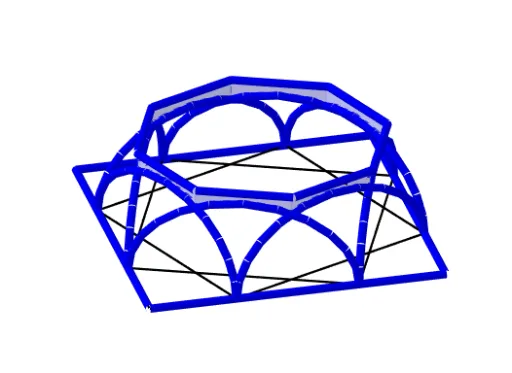
① This example demonstrates a 3D dome-like geometric structure named 'dome 4', built through symmetry, rotation, and mirroring in space. ② Core mathematical concepts include solid geometry (polyhedra and curved surfaces), axial and central symmetry, rotation and reflection transformations, and the projection of quadratic curves (e.g., ellipses) in 3D. ③ Construction highlights: from the summary, the GeoGebra commands used include Segment, Mirror, LineBisector, Polygon, Intersect, Midpoint, Rotate, CircleArc, Point, Plane, Sequence, Distance, and Line, involving objects such as points A to Z, polygon vierhoek1, segments a to h, and plane p. The dome is generated by rotating and mirroring base elements to create a symmetric framework. ④ Suitable for high school or college-level solid geometry lessons, to understand symmetry transformations, rotational solids, and comprehensive use of GeoGebra commands, also useful as an advanced practice exercise.
GeoGebra Commands & Parameters
Segment(A, C) → fMirror(E, f) → IMirror(I, yAxis) → FLineBisector(E, F) → gPolygon(A, B, C, D) → vierhoek1, a, b, c, dIntersect(a, g) → HIntersect(xAxis, yAxis) → OMirror(H, O) → KMirror(E, O) → LMirror(H, f) → JMirror(J, yAxis) → GMidpoint(E, F) → MRotate(F, 90°, g) → F'CircleArc(M, F, F') → ePoint(e) → NPoint(e) → PPoint(e) → QPoint(e) → RPoint(e) → SCircleArc(M, F', E) → hPlane(K, H, M + (0, 0, 1)) → pMirror(T, p) → T'Mirror(V, p) → V'Mirror(W, p) → W'Mirror(Z, p) → Z'Mirror(A_1, p) → B_1Segment(E, B_1) → iSegment(B_1, Z') → jSegment(Z', W') → kSegment(W', V') → lSegment(V', T') → mSegment(T', U) → nSegment(U, T) → qSegment(T, V) → rSegment(V, W) → sSegment(W, Z) → tSegment(Z, A_1) → f_1Segment(A_1, F) → g_1Mirror(l1, sym) → l1'Sequence(Rotate[l1, (nn * 90°), zAxis], nn, 1, 3) → l2Sequence(Rotate[l1', (nn * 90°), zAxis], nn, 1, 3) → l3Midpoint(T, V) → C_1Mirror(C_1, p) → D_1Mirror(E_1, p) → F_1Segment(E, F) → h_1Distance(H, g) → oRotate(E_1, (360°) / 8, zAxis) → G_1Rotate(C_1, (360°) / 8, zAxis) → H_1Polygon(F_1, E_1, 8, xOyPlane) → veelhoek1, i_1, J_1, K_1, L_1, M_1, N_1, j_1, k_1, l_1, m_1, n_1, p_1, q_1, I_1Polygon(D_1, T', U, T, C_1, E_1, F_1) → veelhoek2, d_1, t', u, t_1, c_1, e_1, r_1Line(K_1, F_1) → s_1CircleArc(P_1, F_1, Q_1) → c_2CircleArc(P_1, Q_1, K_1) → d_2Point(c_2) → S_1Point(c_2) → T_1Point(c_2) → U_1Point(c_2) → V_1Segment(R_1, W_1) → a_1Segment(W_1, Z_1) → b_1Segment(Z_1, A_2) → f_2Segment(A_2, B_2) → g_2Segment(B_2, F_1) → h_2Rotate(l5, (360°) / 8, zAxis) → l5'Rotate(W_1, (360°) / 8, zAxis) → C_2Rotate(Z_1, (360°) / 8, zAxis) → D_2Rotate(A_2, (360°) / 8, zAxis) → E_2Rotate(B_2, (360°) / 8, zAxis) → F_2Rotate(F_1, (360°) / 8, zAxis) → G_2Polygon(R_1, W_1, C_2) → driehoek1, i_2, j_2, w_1Polygon(W_1, Z_1, D_2, C_2) → vierhoek2, k_2, z_1, l_2, m_2Polygon(Z_1, A_2, E_2, D_2) → vierhoek3, n_2, a_2, e_2, p_2Polygon(A_2, B_2, F_2, E_2) → vierhoek4, q_2, b_2, r_2, s_2Polygon(B_2, F_1, G_2, F_2) → vierhoek5, t_2, f_3, g_3, h_3Sequence(Rotate[l6, (nn * (360°) / 8), zAxis], nn, 1, 11) → l7Sequence(Rotate[l5, (nn * (360°) / 8), zAxis], nn, 2, 11) → l8Sequence(Rotate[veelhoek2, (nn * (360°) / 8), zAxis], nn, 1, 7) → l4Segment(B, C) → i_3Segment(A, B) → j_3Segment(C, D) → k_3Segment(D, A) → l_3Segment(E, F) → m_3Mirror(E, yAxis) → E'Mirror(K, yAxis) → K'Segment(F, K') → n_3Segment(K', J) → p_3Segment(J, E) → q_3Segment(E', G) → r_3Segment(G, K) → s_3Segment(K, I) → t_3Segment(I, E') → a_3
AI Drawing Prompt Reference
Draw a 3D dome structure generated by symmetry and rotation. Start with a quadrilateral base and one diagonal as an axis of symmetry. Use mirroring and angle bisectors to determine symmetric points, forming the basic framework. Construct circular arcs on both sides of the axis and place several points on them. Mirror some points across an inclined plane to the other side, then connect these points to form the dome's edges. Finally, rotate a set of edges around the vertical axis three times at 90-degree intervals to complete the symmetric dome, adding auxiliary segments and distance marks.
The prompt above was compiled from the original drawing commands and is for reference only.