
Dodecahedron: 3D Solid Geometry with 20 Vertices
Loading the math board and drawing, please wait…
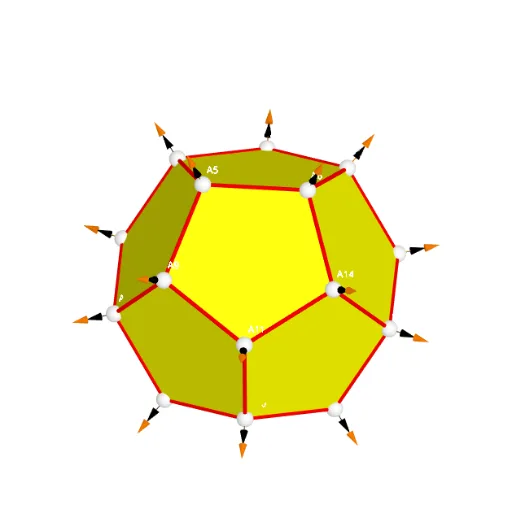
This GeoGebra example demonstrates a regular dodecahedron, a Platonic solid composed of 12 regular pentagonal faces, with 20 vertices and 30 edges. It illustrates key concepts in solid geometry, including properties of regular polyhedra, vertex coordinates in 3D space, and the relationship between the polyhedron and its circumscribed sphere. The construction uses GeoGebra commands such as Sphere to create the circumsphere, UnicodeToLetter, Text, Sum, and Zip for labeling and text generation, and TableText for data tables. Interactive buttons (button7, button2, etc.) control the display, while numerous points (Points00, lll00, etc.) and segments (Segments) define the edges and faces. This resource is suitable for high school or early university students studying solid geometry, polyhedra, or 3D visualization in mathematics.
GeoGebra Commands & Parameters
UnicodeToLetter(34) → u34Text("" + Um1) → txt_pSum(Flatten[Sequence[Append[Sequence[Element[txt_p, i], i, m01(k), m02(k)], " "], k, 1, 5]]) → txtUm1Zip(Vector[a, a + UnitVector[a]], a, Points00) → lVector1Zip(Vector[a, a + (1.5 * UnitVector[b])], a, Points00, b, Wi_Pc) → lVector2Zip(Vector[a, a + (1.5 * UnitVector[b])], a, Points00, b, Wi_P) → lVector3Sphere((0, 0, 0), 5) → sphTableText(Append["i", 1…n], Append[" \fgcolor{orange}{GM :Δφ_i}, rad", l1w], Append["\fgcolor{magenta}{GC :Δφ_i} , rad", l1cw], "v") → text23rZip(Segment[Element[Points00, y(a)], Element[Points00, z(a)]], a, ll1bb(1)) → ll1Zip(Segment[Element[Points00, y(a)], Element[Points00, z(a)]], a, ll1bb(2)) → ll2Zip(Segment[Element[Points00, y(a)], Element[Points00, z(a)]], a, ll1bb(3)) → ll3Zip(Segment[Element[Points00, y(a)], Element[Points00, z(a)]], a, ll1bb(4)) → ll4Zip(Segment[Element[Points00, y(a)], Element[Points00, z(a)]], a, ll1bb(5)) → ll5