
Dividing a Cube into Pyramids
Loading the math board and drawing, please wait…
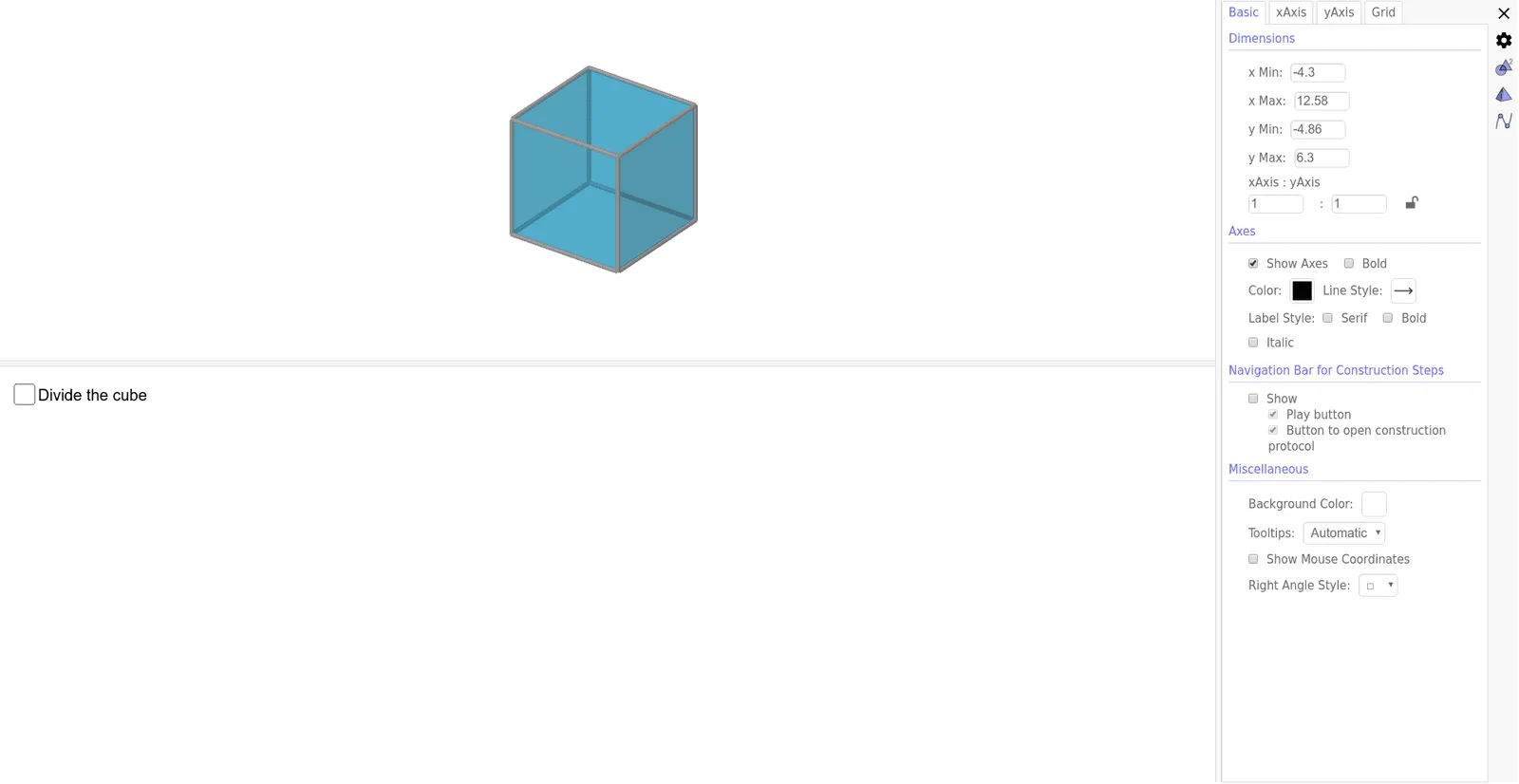
① This example demonstrates how to divide a cube into several pyramids (both quadrangular and triangular) by connecting an interior point to the cube's vertices, visually illustrating the decomposition of a solid and volume relationships. ② Core mathematical concepts include solid geometry: pyramids, cube, quadrangular pyramid, triangular pyramid, and the additive principle of volume through partitioning. ③ Construction highlights: using GeoGebra commands such as Cube to create the cube, Midpoint and OrthogonalLine to define an interior point, Pyramid to construct each pyramid, Rotate for viewing angles, and Segment and If for auxiliary construction and display; objects include the cube's six faces, twelve edges, and multiple pyramid faces. ④ Suitable for upper secondary or early university students, useful for teaching solid geometry, developing spatial reasoning, and exploring the relationship between pyramid volumes and the cube's volume.
GeoGebra Commands & Parameters
If(t < 0.5, (2 * t), 1) → t1Cube(A, B, xOyPlane) → a, C, faceBCGF, faceCDHG, faceEFGH, edgeAD, edgeAB, edgeBC, edgeCD, edgeAE, edgeDH_1, edgeEH_1, D, edgeEF, edgeBF, edgeFG, edgeCG, edgeGH_1, E, F, G, H, faceABCD, faceADHE, faceABFEPyramid(faceABCD, H) → b, faceADH, faceABH_1, faceBCH_1, faceCDH, edgeDH, edgeAH_1, edgeBH_1, edgeCH_1Pyramid(faceBCGF, H) → c, faceBCH, faceBFH_1, faceFGH, faceCGH, edgeCH, edgeBH_2, edgeFH_1, edgeGHPyramid(faceABFE, H) → d, faceABH, faceAEH, faceEFH, faceBFH, edgeBH, edgeAH, edgeEH, edgeFHRotate(E, (90° * t1), edgeAB) → E'Midpoint(E', B) → IOrthogonalLine(I, Polygon[A, I, B]) → eRotate(G, (90° * t1), edgeBC) → G'Midpoint(B, G') → JOrthogonalLine(J, Polygon[B, C, G']) → fRotate(Pyramid[faceABCD, H], 0°, edgeDH) → b'If(t ≥ 0.5, (2 * (t - 0.5)), 0) → t2Rotate(Rotate[c, (90° * t1), edgeBC], (-((90° * t2))), f) → c'Rotate(Rotate[d, (90° * t1), edgeAB], ((-(90°)) * t2), e) → d'Segment(A, B) → gSegment(B, C) → hSegment(C, D) → iSegment(D, A) → jSegment(A, E) → kSegment(B, F) → lSegment(C, G) → mSegment(D, H) → nSegment(E, F) → pSegment(F, G) → qSegment(G, H) → rSegment(H, E) → s
AI Drawing Prompt Reference
Draw a cube divided into several pyramids. The cube has six faces and twelve edges. First, determine an interior point, then connect it to the cube's vertices to form quadrangular and triangular pyramids. Show the faces of these pyramids and the connection lines. The drawing should clearly illustrate the decomposition of the cube and the principle of volume addition.
The prompt above was compiled from the original drawing commands and is for reference only.