
Divide a Line Segment into Equal Parts
Loading the math board and drawing, please wait…
In collections
Introduction to Geometry
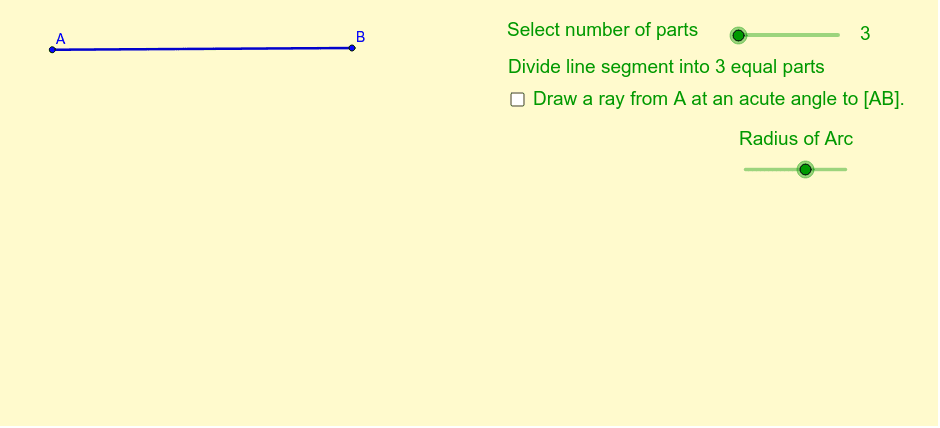
This example demonstrates how to divide a line segment into 3, 4, or 5 equal parts. Through a dynamic diagram, students can intuitively understand the basic principles of geometric construction. Key mathematical concepts include geometric construction, line segment division, and geometric transformations. GeoGebra commands used include Circle, Ray, OrthogonalLine, Intersect, Segment, Line, and CircleArc. Suitable for middle school and above students to learn geometric construction.
GeoGebra Commands & Parameters
Circle(C, 0.55) → e_1Ray(A, C) → bOrthogonalLine(C, b) → iIntersect(e_1, i) → P, QSegment(A, B) → aLine(Q, b) → fLine(P, b) → eCircle(A, Radius) → gCircle(A, (2 * Radius)) → hCircle(A, (3 * Radius)) → kCircle(A, (4 * Radius)) → pCircle(A, (5 * Radius)) → qIntersect(g, f, 2) → FIntersect(g, e, 2) → GIntersect(h, f, 2) → HIntersect(h, e, 2) → IIntersect(k, f, 2) → JIntersect(k, e, 2) → KIntersect(p, f, 2) → LIntersect(p, e, 2) → MIntersect(q, f, 2) → NIntersect(q, e, 2) → OCircleArc(A, G, F) → rCircleArc(A, I, H) → sCircleArc(A, K, J) → tCircleArc(A, M, L) → c_1CircleArc(A, O, N) → d_1Intersect(r, b, 1) → RIntersect(s, b, 1) → SIntersect(t, b, 1) → TIntersect(c_1, b, 1) → UIntersect(d_1, b) → V,Segment(V, B) → jLine(U, j) → lLine(T, j) → mLine(S, j) → nLine(R, j) → a_1Intersect(l, a) → WSegment(U, W) → b_1Intersect(m, a) → ZSegment(T, Z) → f_1Intersect(n, a) → A_1Segment(S, A_1) → g_1Intersect(a_1, a) → B_1Segment(R, B_1) → h_1Segment(U, B) → i_1Line(T, i_1) → j_1Line(S, i_1) → k_1Line(R, i_1) → l_1Intersect(l_1, a) → C_1Intersect(k_1, a) → D_1Intersect(j_1, a) → E_1Segment(T, E_1) → m_1Segment(S, D_1) → n_1Segment(R, C_1) → p_1Segment(T, B) → q_1Line(S, q_1) → r_1Line(R, r_1) → s_1Intersect(s_1, a) → F_1Intersect(r_1, a) → G_1Segment(R, F_1) → t_1Segment(S, G_1) → a_2CircleArc(A, M, L) → c_2