
Divide a Cube into Two Parts by Diego Lieban
Loading the math board and drawing, please wait…
In collections
Dissecting a cube into equal parts
Developing games and puzzles with 3D printing for STEAM
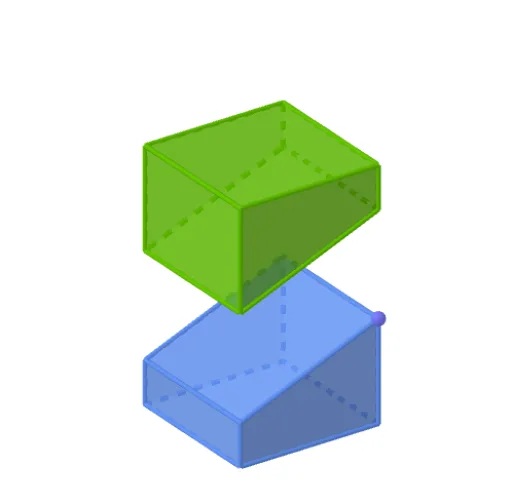
This example demonstrates how to divide a cube into two equal parts. Key mathematical concepts include solid geometry and geometric construction. Using GeoGebra commands such as Intersect, Point, Cube, Midpoint, Plane, Sphere, Segment, Polygon, Vector, and Transform, the process of dividing the cube is visually demonstrated. Suitable for middle school and above students to learn solid geometry and geometric construction.
GeoGebra Commands & Parameters
Intersect(yAxis, zAxis) → APoint(xAxis) → BPoint(Circle[B, Distance[A, B], Segment[A, B]]) → CCube(A, B, C) → a, D, faceCDHG, faceEFGH, edgeAD, edgeAB, edgeBC, edgeCD, edgeAE, edgeDH, edgeEH, edgeEF, E, edgeBF, edgeFG, edgeCG, edgeGH, F, G, H, faceABCD, faceADHE, faceABFE, faceBCGFMidpoint(edgeBF) → IPlane(I, xOyPlane) → bMidpoint(edgeCG) → JMidpoint(edgeDH) → KMidpoint(edgeAE) → LPoint(edgeDH) → MSphere(C, Distance[H, M]) → cIntersect(edgeCG, c) → N, TSegment(N, M) → fSphere(E, Distance[H, M]) → dIntersect(edgeAE, d) → P, OPlane(P, M, N) → eIntersect(edgeBF, e) → QPolygon(E, P, Q, F) → q1, e_1, p, q, f_1Polygon(F, G, N, Q) → q2, f_2, g, n, q_1Polygon(G, N, M, H) → q3, g_1, n_1, m, hPolygon(H, E, P, M) → q4, h_1, e_2, p_1, m_1Polygon(N, Q, P, M) → q5, n_2, q_2, p_2, m_2Sphere(A, i) → jIntersect(zAxis, j) → R, SVector(A, S) → uTranslate(q3, u) → q3'Translate(faceEFGH, u) → faceEFGH'Translate(q1, u) → q1'Translate(q2, u) → q2'Translate(q4, u) → q4'Translate(q5, u) → q5'Polygon(N, C, D, M) → q6, n_3, c_1, d_1, m_3Polygon(M, P, A, D) → q7, m_4, p_3, a_1, d_2Polygon(P, Q, B, A) → q8, p_4, q_3, b_1, a_2Polygon(Q, N, C, B) → q9, q_4, n_4, c_2, b_2Polygon(A, D, C, B) → q10, a_3, d_3, c_3, b_3Polygon(M, P, Q, N) → q11, m_5, p_5, q_5, n_5
AI Drawing Prompt Reference
Draw a cube and demonstrate how to divide it into two equal parts. First, mark the intersection points of the coordinate axes and key points of the cube, then construct the cube using these points. Next, find the midpoints of the cube's edges and use these midpoints and spheres to determine the division lines. Finally, translate the divided parts along a direction to show the two halves of the cube.
The prompt above was compiled from the original drawing commands and is for reference only.