
Distance-Time Graph for Adam's Run
Loading the math board and drawing, please wait…
In collections
CCSS Support Algebra I Unit 3
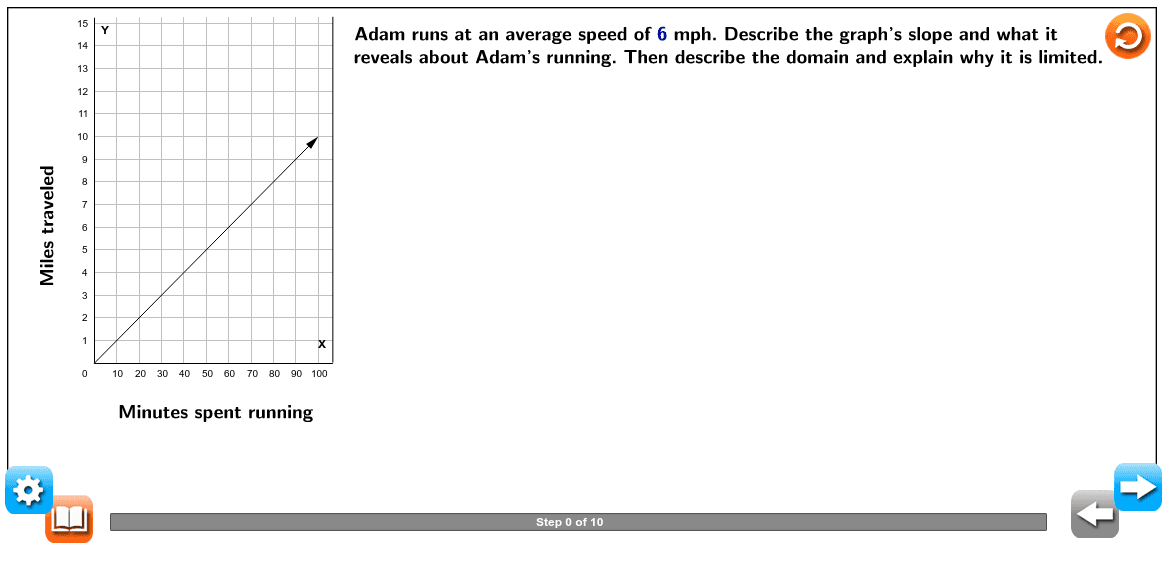
This example demonstrates how Adam's running distance changes over time. Key mathematical concepts include function graphs and velocity-time relationships. Using GeoGebra commands such as Vector, Point, and Intersect, an intuitive distance-time graph is constructed. Suitable for middle school and above students to learn function graphs and practical applications.
GeoGebra Commands & Parameters
SelectedIndex(Miles) → GetmilesVector(A, B) → uOrthogonalLine(B, xAxis) → bOrthogonalLine(B, b) → cPoint(c) → COrthogonalLine(C, c) → dPoint(xAxis) → DOrthogonalLine(D, d) → eIntersect(b, e) → ESegment(B, C) → ToplinefSegment(B, E) → SidelinegPolygon(F, G, H, I) → GCSplitpoly1, f, g, h, iPolygon(J, K, L, M) → Gtoppoly1, j, k, l, mSegment(N, O) → nSegment(N, P) → pSegment(P, Q) → qIntersect(f, k) → RPoint(f) → SSegment(R, S) → rLaTeX("\text{Minutes spent running}") → XGraminsVerticalText("Miles traveled") → YGramilLaTeX("\text{Describe the slope of the line.}") → PG1ELaTeX("\text{The line increases from left to right; therefore, its slope is positive.}") → PG1FLaTeX("\text{Explain what the slope of the line reveals about Adam’s running.}") → PG1ILaTeX("\text{Because the slope is positive and the function increases as time passes, this means}") → PG1JLaTeX("\text{that the longer Adam runs, the farther he will go.}") → PG1KLaTeX("\text{Describe the domain.}") → PG2ALaTeX("\text{The graph starts at the origin and continues through Quadrant I. No negative values}") → PG2CLaTeX("\text{Explain why the domain is limited.}") → PG2ELaTeX("\text{Note that the scale on the \textcolor{#000099}{x}-axis is in increments of \textcolor{#000099}{5} instead of \textcolor{#000099}{1}. If the scale on}") → PG1GLaTeX("\text{the \textcolor{#000099}{x}-axis were the same as the scale on the \textcolor{#000099}{y}-axis, the slope would be steeper.}") → PG1HLaTeX("\text{The domain is the set of all possible \textcolor{#000099}{x}-values for a function.}") → PG2BLaTeX("\text{for \textcolor{#000099}{x} are shown. Thus, the domain is \textcolor{#000099}{x ≥ 0}.}") → PG2DLaTeX("\text{In this situation, \textcolor{#000099}{x} represents the amount of time Adam spends running. Because}") → PG2FLaTeX("\text{it is impossible to have a negative amount of time, \textcolor{#000099}{x} cannot be less than \textcolor{#000099}{0}.}") → PG2GLaTeX("\text{Therefore, the domain is limited to values greater than or equal to \textcolor{#000099}{0}.}") → PG2HIntersect(l, m) → A_1Polygon(A_1, D_1, E_1, F_1) → Hideright, a_1, d_1, e_1, f_1Point(k) → G_1Point(q) → H_1Segment(G_1, H_1) → sPolygon(I_1, K_1, L_1, M_1) → Gtopnew, i_1, k_1, l_1, m_1LaTeX((("\text{ Adam runs at an average speed of \textcolor{#000099}{" * Getmiles) * "} mph. Describe the graph’s slope and what it}")) → PG1ALaTeX("\text{ reveals about Adam’s running. Then describe the domain and explain why it is limited.}") → PG1CLaTeX("\text{\mathbf{slope} the measure of the rate of change of one variable with respect to another }") → text3LaTeX("\text{without restriction}") → text2LaTeX("\text{\mathbf{domain} the set of all input values (\textcolor{#000099}{x}-values) that satisfy the given function }") → WTK4LaTeX("\text{variable;\textcolor{#000099}{slope=\frac{y₂-y₁}{x₂-x₁}=\frac{\Delta y}{\Delta x}=\frac{rise}{run}}; the slope in the equation \textcolor{#000099}{{y = mx + b}} is \textcolor{#000099}{m}.}") → text5
AI Drawing Prompt Reference
Create a distance-time graph showing how a person's running distance changes over time. Include a line with a positive slope indicating increasing distance, starting from the origin and extending into the first quadrant. Label the x-axis as time (minutes) and the y-axis as distance (miles). Add text annotations explaining that the positive slope represents constant speed and forward motion, and why the domain is limited to non-negative values as time cannot be negative.
The prompt above was compiled from the original drawing commands and is for reference only.