
Disk Method Derivation
Loading the math board and drawing, please wait…
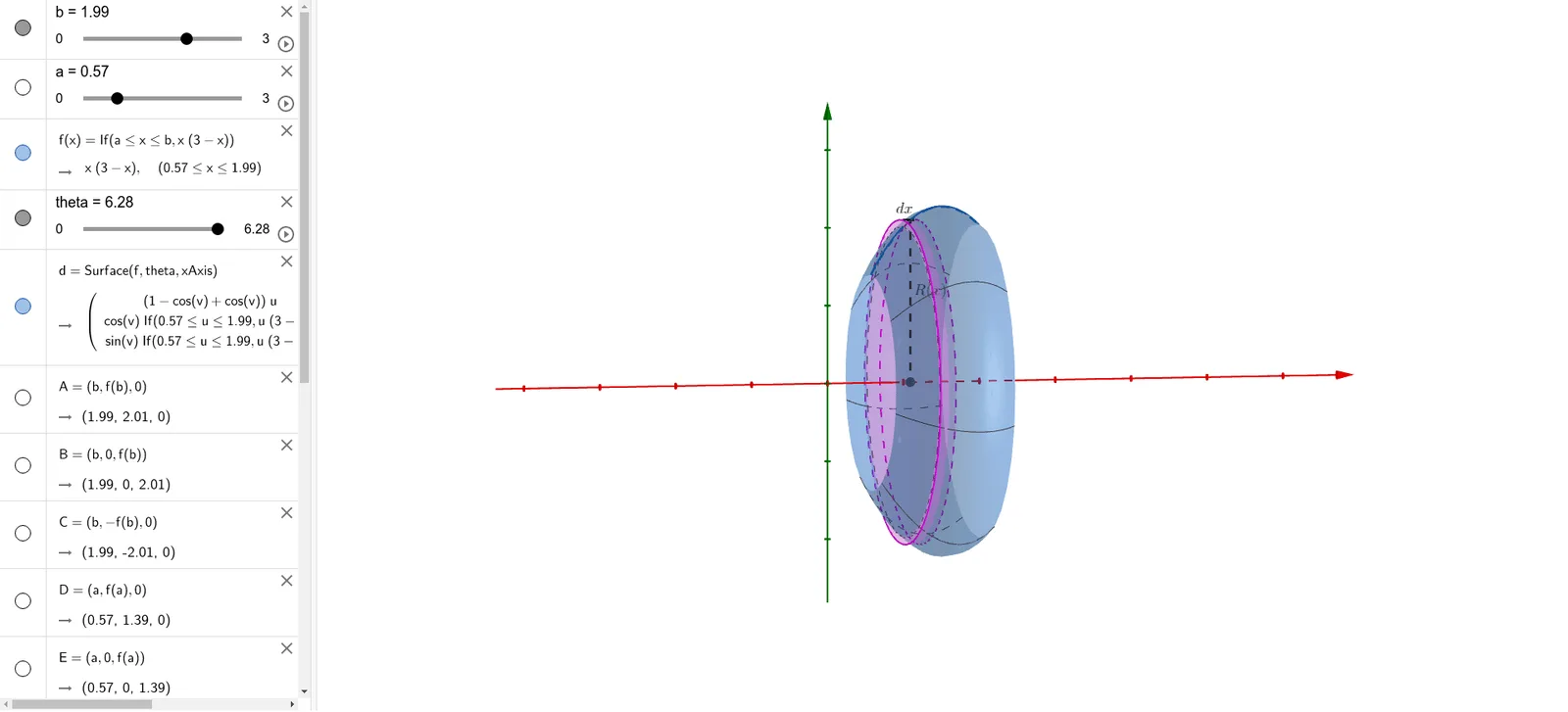
This example demonstrates the Disk Method in Calculus for calculating the volume of a solid of revolution. Key math concepts include Integral Calculus, Conic Sections, and Volume Calculation. Constructed using GeoGebra commands like Circle, Segment, Line, Surface, and Cylinder. Ideal for university calculus courses or advanced math learners.
GeoGebra Commands & Parameters
Circle(D, E, F) → eSegment(G, (c, f(c), 0)) → jSegment((c + dx / 2, f(c), 0), (c - dx / 2, f(c), 0)) → lLine(H, I) → mSurface(f, theta, m) → dCylinder((c - dx / 2, ax, 0), (c + dx / 2, ax, 0), f(c) - ax) → g, g_{2}, g_{3}, g_{4}
AI Drawing Prompt Reference
Draw a demonstration of the Disk Method in integral calculus showing volume calculation of a solid of revolution. Include a circle, a line segment from the function graph to the x-axis, and a rotating surface below the function graph. Start by drawing the circle and line segment, then generate the rotating surface, and finally show the volume calculation process.
The prompt above was compiled from the original drawing commands and is for reference only.