
Discovering Area of a Regular Pentagon
Loading the math board and drawing, please wait…
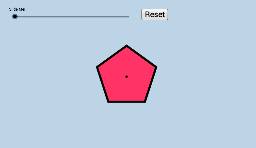
This example demonstrates how to find the area of a regular polygon (specifically a pentagon) through peeling or dissection. Key math concepts include polygon area formulas, geometric dissection, and angle bisectors. GeoGebra commands and objects used in construction are Polygon, Circle, Center, Segment, Sequence, Mirror, OrthogonalLine, Intersect, Rotate, Angle, and Dilate. Ideal for high school students to understand area calculation methods for complex polygons.
GeoGebra Commands & Parameters
Polygon(A, B, a) → poly1, b, n, p_2, q, r, s, t, a_1, b_1, c_1, d_1, c, e_1, f_1, g_1, h_1, i_1, j_1, k_1, l_1, m_1, n_1, d, p_1, q_1, r_1, s_1, t_1, a_2, b_2, c_2, d_2, e_2, e_3, f_2, C, D, E, F, G, H, I, L, M, f, N, O, P, Q, R, S, T, U, V, W, g, Z, A_1, B_1, C_1, D_1, E_1, F_1, G_1, H_1, I_1, h, J_1, K_1, L_1, M_1, N_1, O_1, P_1, Q_1, R_1, i, jCircle(A, B, C) → kCenter(k) → JSegment(J, C) → n_2Segment(J, B) → m_2Sequence(Segment[Dilate[A, k, J], Dilate[B, k, J]], k, 0.05, 0.95, 0.05) → list1Mirror(list1, m_2) → list1'Mirror(list1', n_2) → list1''OrthogonalLine(J, b) → lMirror(list1'', l) → list1'''Intersect(Element[list1'', 19], Element[list1''', 19]) → W_1Intersect(l, b) → KSegment(J, K) → mRotate(K, (360 * ° / a), J) → K'Angle(K, J, K') → αRotate(B, (-α), B) → B'Intersect(l, poly1) → S_1, T_1Dilate(J, If[-1 < o ≤ 0, (-o), 0], W_1) → J'Segment(J, J') → g_2Dilate(J, If[-2 < o ≤ -1, -1 - o, 0], K) → J'_1Segment(J, J'_1) → i_2Angle(B, K, J) → βDilate(J, If[-1 < e ≤ 0, (-e), 0], T_1) → J'_2Dilate(J, If[-2 < e ≤ -1, -1 - e, 0], K) → J'_3Segment(J, J'_3) → pSegment(J, J'_2) → j_2Segment(J, J'_3) → k_2Segment(J, J'_2) → l_2Mirror(list1', l) → list1''_1Rotate(C, If[0 ≤ o ≤ 1, ((-o) * α), (-α)], C) → C'Rotate(D, If[0 ≤ o ≤ 1, ((-o) * α), (-α)], C) → D'Segment(C', D') → d'Mirror(C', l) → C''Mirror(D', l) → D''Segment(C'', D'') → d''Segment(B, D') → q_2Segment(A, D'') → r_2Rotate(B, If[1 < o ≤ 2, ((-(o - 1)) * α), (-α)], B) → B'_1Rotate(D', If[1 < o ≤ 2, ((-(o - 1)) * α), (-α)], B) → D''_1Segment(B'_1, D''_1) → s_2Mirror(B'_1, l) → U_1Mirror(D''_1, l) → V_1Segment(U_1, V_1) → t_2Segment(V_1, D''_1) → a_3Sequence(Intersect[Element[list1', k], Element[list1'', k]], k, 1, 19, 1) → list2Sequence(Rotate[Element[list1'', k], If[2 < o ≤ 3, ((-(o - 2)) * α), (-α)], Element[list2, k]], k, 1, 19, 1) → list4Mirror(list4, g_2) → list4'Sequence(Intersect[Element[list1, k], Element[list1', k]], k, 1, 19, 1) → list6Sequence(Rotate[Element[list1', k], If[3 < o ≤ 4, ((-(o - 3)) * α), (-α)], Element[list6, k]], k, 1, 19, 1) → list3Sequence(Rotate[Element[list4, k], If[3 < o ≤ 4, ((-(o - 3)) * α), (-α)], Element[list6, k]], k, 1, 19, 1) → list5Mirror(list5, g_2) → list5'Mirror(list3, g_2) → list3'Dilate(J, If[4 < o ≤ 5, 5 - o, 0], V_1) → J'_4Segment(J, J'_4) → b_3Dilate(J, If[4 < o ≤ 5, 5 - o, 0], D''_1) → J'_5Segment(J, J'_5) → c_3