
Direction Angles, Cosines, and Ratios
Loading the math board and drawing, please wait…
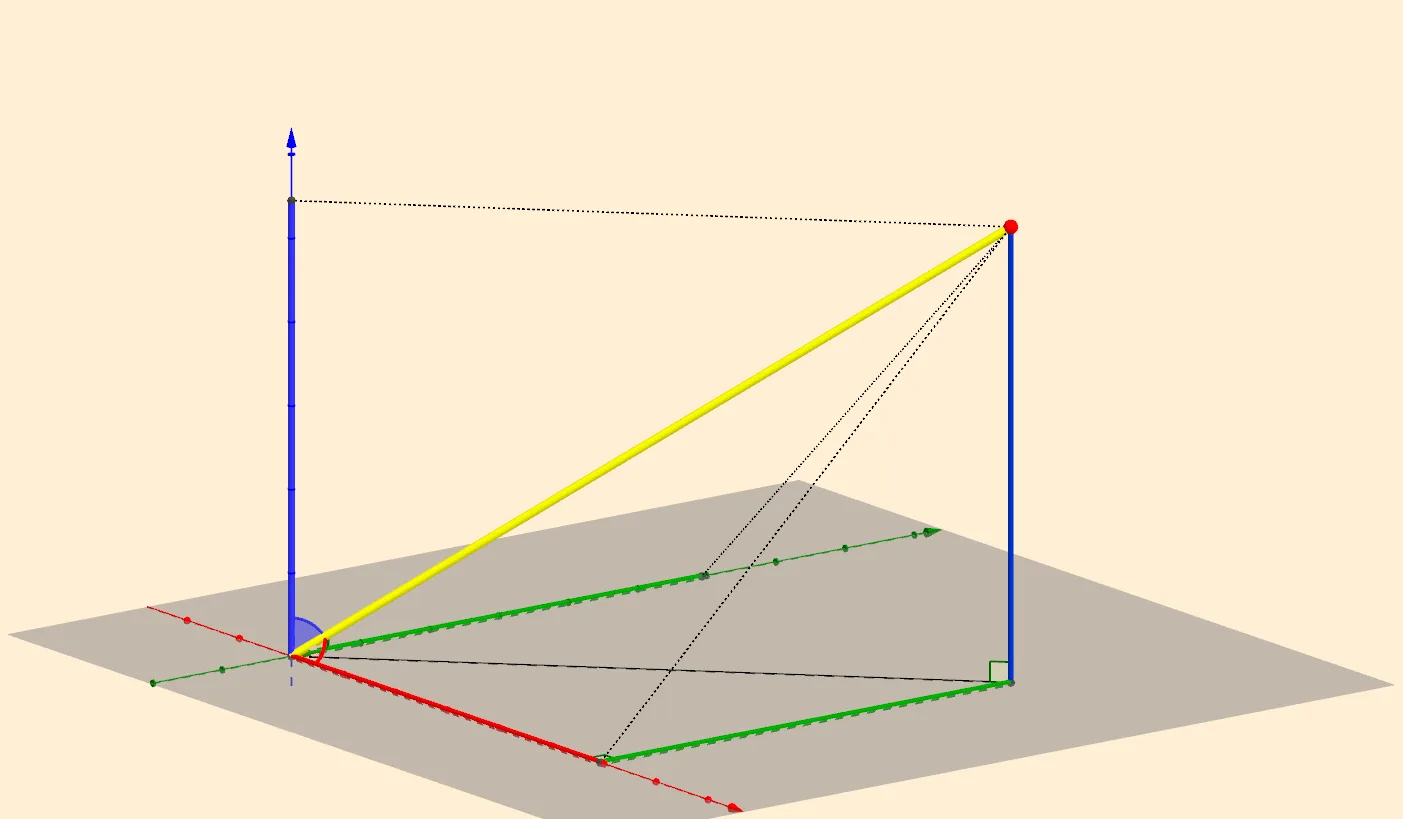
This example illustrates the concepts of direction angles, cosines, and ratios. It involves basic knowledge of trigonometry and vectors. Using commands like rotation, intersection, and vector, users can dynamically explore the direction angles and cosine values of vectors in three-dimensional space. Suitable for high school mathematics education, particularly in coordinate geometry and vector courses.
GeoGebra Commands & Parameters
Intersect(xAxis, yAxis) → OCircle(O, 1) → c_1Intersect(c_1, xAxis, 2) → Q_1Rotate(Q_1, θ_., O) → QIntersect(yAxis, xAxis) → ASegment(A, P) → fOrthogonalLine(P, xOyPlane) → gIntersect(g, xOyPlane) → COrthogonalLine(C, xAxis, space) → hIntersect(h, xAxis) → DSegment(A, D) → iSegment(D, C) → jVector(A, P) → uAngle(D, A, P) → αPoint(yAxis) → BPoint(zAxis) → EAngle(P, A, E) → γAngle(P, A, B) → βLength(i) → x_.Length(j) → y_.OrthogonalLine(P, xAxis, space) → lOrthogonalLine(P, zAxis, space) → mOrthogonalLine(P, yAxis, space) → nIntersect(l, xAxis) → FIntersect(m, zAxis) → GIntersect(n, yAxis) → HSegment(F, A) → pSegment(A, G) → qIntersect(γ, yAxis, 1) → IIntersect(yAxis, xAxis) → JSegment(H, A) → sSegment(P, F) → tSegment(G, P) → cSegment(H, P) → dLength(p) → a_.Length(s) → b_.Length(q) → c_.Midpoint(A, F) → KMidpoint(A, H) → LMidpoint(A, G) → MMidpoint(f) → NAngle(Q_1, O, Q) → θ_…Segment(O, Q) → f_1OrthogonalLine(Q, xAxis) → g_1Intersect(g_1, xAxis) → RSegment(Q, R) → h_1Segment(R, O) → i_1Midpoint(i_1) → SMidpoint(h_1) → TVector(R, Q) → wVector(O, R) → u_1Segment(P, C) → j_1Segment(A, C) → k_1Angle(A, C, P) → δAngle(A, D, C) → ε