
Monkey and Hunter Parabolic Motion
Loading the math board and drawing, please wait…
In collections
El dominio del Tiempo (cinemática intuitiva)
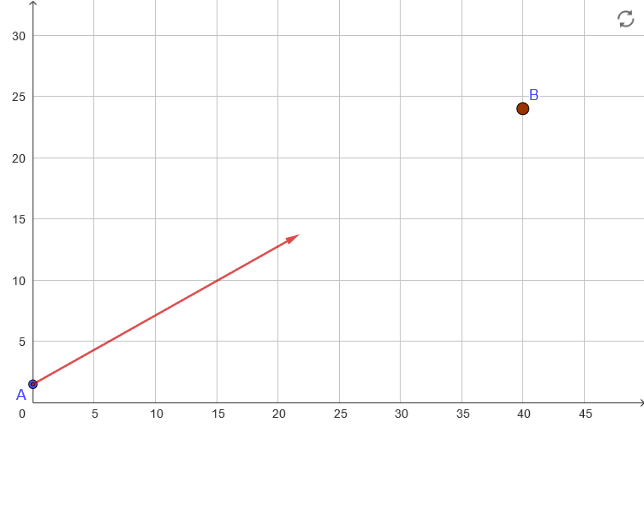
This example demonstrates the parabolic motion between a monkey and a hunter, simulating ballistic trajectories. Key math concepts include 2D vectors, geometric constructions, similar triangles, probability & statistics, and parametric equations. Construction highlights use of GeoGebra commands like Polygon, PointIn, Vector, Textfield, If, PolyLine, involving objects such as vector v0, gravity g, and time t. Suitable for high school physics and mathematics education to understand parabolic motion principles and calculations.
GeoGebra Commands & Parameters
Polygon((0, 0), (0, 10^(6)), (10^(6), 10^(6)), (10^(6), 0)) → a, h, i, j, lPointIn(a) → APointIn(a) → BVector(A, P) → v0Vector((x(M), y(A)), (x(M) + v0x, y(A))) → vxVector((x(A), y(A)), (x(A), y(A) + v0y)) → vyTextfield(r) → CasillaDeEntrada1Vector(M, M + v) → vvIf(v0x ≟ 0 ∧ v0y ≥ 0, (v0y + sqrt(((2 * y(A - B)) * abs(g)) + v0y^(2))) / abs(g), v0x ≟ 0 ∧ v0y < 0, (v0y - sqrt(((2 * y(A - B)) * abs(g)) + v0y^(2))) / abs(g), x(B - A) / v0x) → TteorPolyLine(reg) → pol
AI Drawing Prompt Reference
Draw a 2D coordinate plane with a large square viewing frame. Inside it, mark a starting point for the monkey and a target point for the hunter. From the start, construct the initial-velocity vector and also its horizontal and vertical components as separate vectors. Then generate the ballistic (parabolic) trajectory between the two points using a parametric/time-based construction: compute a theoretical travel time from the geometric relation between the start and target and a gravity constant, and use it to build a polyline that traces the projectile path. Include a text field area for entering parameters, reflecting how the motion depends on the initial vector and gravity.
The prompt above was compiled from the original drawing commands and is for reference only.