
Dilation Transformation Demo by Erica Bach
Loading the math board and drawing, please wait…
In collections
Dilations
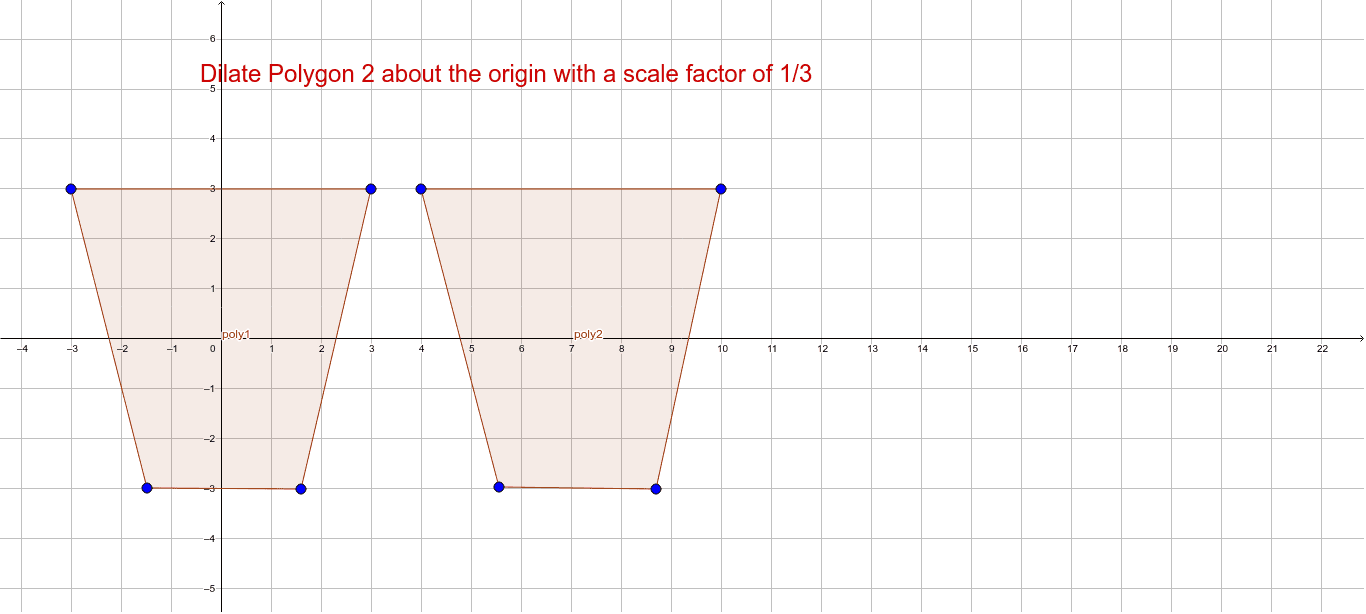
This example demonstrates the effect of dilation transformation on polygons in three-dimensional space. It involves core mathematical concepts such as vectors, function graphs, natural numbers, Pythagorean theorem, and trigonometry. The construction uses commands like Polygon and objects including A, B, C, D, poly1, a, b, c, d, E, F, G, H, poly2, e, f, g, h, text1. It is suitable for high school and above students to learn geometric transformations, vector operations, and properties of three-dimensional figures.
GeoGebra Commands & Parameters
Polygon(A, B, C, D) → poly1, a, b, c, dPolygon(E, F, G, H) → poly2, e, f, g, h
AI Drawing Prompt Reference
Draw a three-dimensional geometric figure showing a dilation transformation between two quadrilaterals. Construct the first quadrilateral with four vertices connected in order, then construct a second quadrilateral with another set of four vertices, also connected in order. The two quadrilaterals should be positioned in space to demonstrate a scaling or stretching effect, with corresponding edges suggesting a proportional relationship. Include both polygon faces and the connecting edges to clearly show the transformation. The figure should illustrate concepts of vectors, functions, and trigonometry in a solid geometry context.
The prompt above was compiled from the original drawing commands and is for reference only.