
Dilation of Polygons in 3D Space
Loading the math board and drawing, please wait…
In collections
Dilations
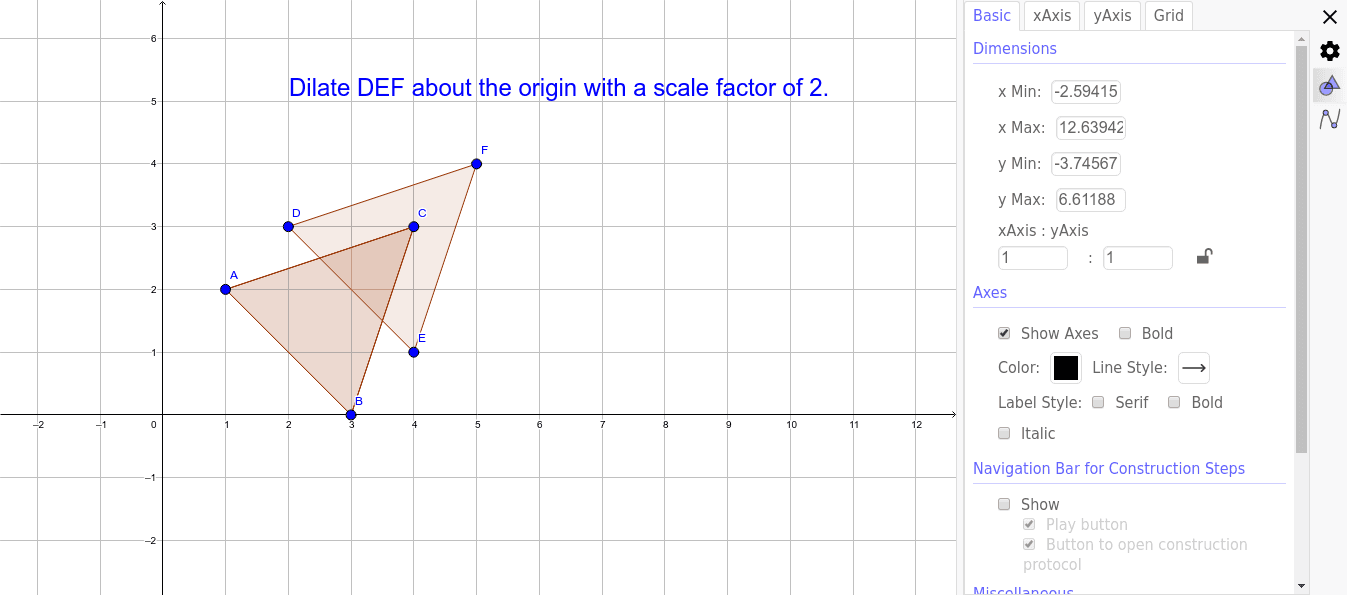
①This example demonstrates the process of dilating (scaling) a polygon (triangle) in three-dimensional space, showing both the original and transformed shapes. ②The core mathematical concept is geometric transformation, specifically dilation, involving similarity, scale factor, and coordinate transformations in 3D. ③Construction highlights: Based on the construction summary, the GeoGebra commands include Polygon to create multiple polygons (poly1, poly2, poly3), with corresponding vertices (A, B, C, D, E, F) and edges (a, b, c, d, e, f), plus a text object (text1) for labeling or explanation. ④This is suitable for middle or high school geometry or solid geometry classes, helping students intuitively understand how dilation affects shape and size, and explore relationships between scale factor and area/volume changes.
GeoGebra Commands & Parameters
Polygon(A, B, C) → poly1, c, a, bPolygon(A, B, C) → poly2, c_1, a_1, b_1Polygon(D, E, F) → poly3, f, d, e
AI Drawing Prompt Reference
Draw a triangle in 3D space, then show two transformed copies of it. First, create the original triangle using three vertices. Then, create an identical overlapping triangle using the same vertices as a reference. Next, choose three new vertices in space to form a scaled (enlarged or reduced) triangle that remains similar to the original. Use distinct colors or line styles to differentiate the original, reference, and scaled triangles, and add a text label to explain the dilation. The overall composition should clearly illustrate the geometric transformation in three dimensions.
The prompt above was compiled from the original drawing commands and is for reference only.