
Dilation Line
Loading the math board and drawing, please wait…
In collections
Dilations
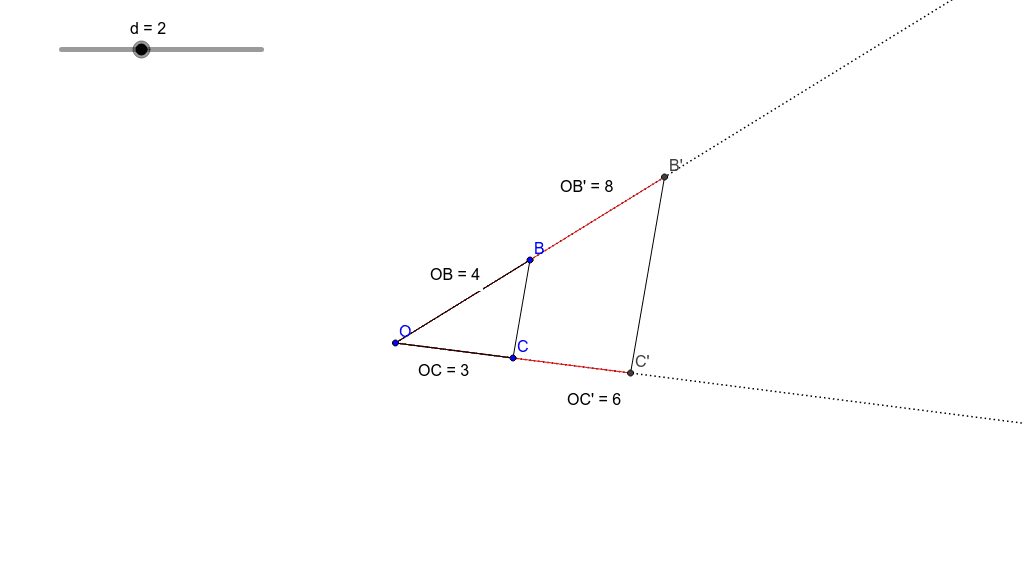
This example illustrates the linear relationship in similarity transformations. Key mathematical concepts include similarity transformations, segment ratios, and distances. Using GeoGebra commands such as Polygon, Intersect, Segment, and Ray, the essential elements of similarity transformations are constructed. Suitable for high school mathematics education and learning about similarity transformations.
GeoGebra Commands & Parameters
Polygon(Dilate[B, d, O], Dilate[C, d, O], Dilate[O, d, O]) → poly1, a, b, cIntersect(a, c) → B'Intersect(a, b) → C'Segment(O, B) → eSegment(O, C) → fRay(O, B') → gRay(O, C') → hSegment(O, B') → iDistance(O, B) → distanceOBDistance(O, B') → distanceOB'Distance(O, C) → distanceOCDistance(O, C') → distanceOC'Segment(O, C') → jSegment(B, C) → kSegment(B', C') → lSegment(O, B) → mSegment(O, C) → n
AI Drawing Prompt Reference
Draw a diagram illustrating the linear relationship in similarity transformations, including a center point, two initial points, and their corresponding dilated points. Connect the center point to the initial points with line segments, draw rays from the center to the dilated points, and display the distances between the initial and corresponding points. Finally, connect the initial and corresponding points with line segments to show the ratio relationships in the similarity transformation.
The prompt above was compiled from the original drawing commands and is for reference only.