
Dilation-Based Splitting of Triangle Sides (Part 2)
Loading the math board and drawing, please wait…
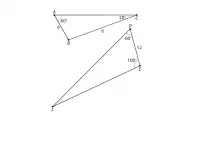
This example demonstrates how to split the sides of a triangle into segments with a prescribed ratio using dilation (a scaling transformation) and similarity reasoning. The key ideas are triangle similarity, dilation with a center and scale factor, and the resulting proportionality between corresponding sides/segments. In GeoGebra, the construction typically begins by creating the triangle and identifying the dilation center (and the relevant points on the sides). Then a dilation is defined, mapping the appropriate reference points to new points that lie on the triangle’s sides; those image points become the required splitting points. Finally, segment lengths or distance ratios are checked to confirm that the split satisfies the intended similarity-based proportional relationship. Suitable for secondary-level geometry practice and for lessons focused on geometric transformations and similarity.
AI Drawing Prompt Reference
Draw a triangle and choose one vertex as the dilation center. From this center, apply a scaling transformation to a reference point on one side so that its image lies on another side, dividing that side in a given ratio. Repeat similar scaling for the other two sides to obtain three splitting points. Finally, connect these points to the corresponding vertices and label the segment length ratios to illustrate triangle similarity and proportionality.
The prompt above was compiled from the original drawing commands and is for reference only.