
Dihedral Angle of Two Faces in a Cube
Loading the math board and drawing, please wait…
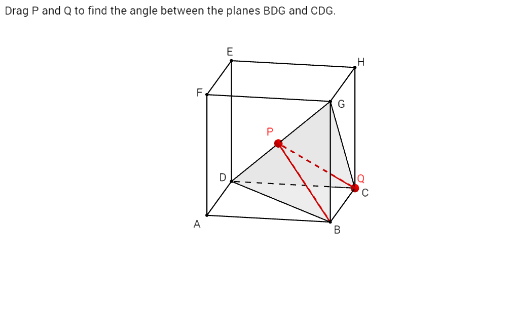
① This example demonstrates the dihedral angle between two adjacent faces of a cube in 3D space, visualizing the angle formed by two half-planes along their common edge. ② The core mathematical concept is the dihedral angle in solid geometry, defined as the angle between two planes measured in a plane perpendicular to their intersection line. ③ Construction highlights: using GeoGebra commands such as Point, Cube, Polygon to build the cube and its faces; OrthogonalPlane to create a plane perpendicular to the edge; Intersect to find intersection lines; Segment to connect key points; and Angle to measure the dihedral angle. ④ Suitable for high school solid geometry or introductory college geometry, helping students understand spatial angle measurement and gain familiarity with dynamic 3D geometry software.
GeoGebra Commands & Parameters
Point(Circle[B, Distance[A, B], Segment[A, B]]) → CCube(A, B, C) → a, D, faceCDHG, faceEFGH, edgeAD, edgeAB, edgeBC, edgeCD, edgeAE, edgeDH, edgeEH, edgeEF, F, edgeBF, edgeFG, edgeCG, edgeGH, G, H, E, faceABCD, faceADHE, faceABFE, faceBCGFPolygon(D, B, G) → poly1, g, d, bPolygon(D, C, G) → poly2, g_1, d_1, cOrthogonalPlane(B, c) → eIntersect(c, e) → ISegment(D, I + (0.05 * (D - G))) → fSegment(G, I + (0.05 * (G - D))) → hPoint({f, I, h}) → JSegment(B, J) → jAngle(D, J, B) → αOrthogonalPlane(J, b) → iIntersect(d_1, i) → KSegment(G, K + (0.05 * (G - C))) → kSegment(C, K + (0.05 * (C - G))) → lPoint({l, K, k}) → LSegment(L, J) → mSegment(B, J) → nAngle(L, J, G) → βAngle(B, J, L) → γ
AI Drawing Prompt Reference
Draw a 3D cube. Select two adjacent faces sharing an edge. At a point on this edge, construct a plane perpendicular to the edge, intersecting both faces to form two lines. Draw segments from the edge point to these lines, creating an angle between the two half-planes. Repeat a similar construction on another edge to form a second angle. Label both angles to show the dihedral angles between adjacent faces of the cube.
The prompt above was compiled from the original drawing commands and is for reference only.